Article Overview
Companies face growing pressure to align with ISO/IEC 42001, the world’s first standard for Artificial Intelligence Management Systems (AIMS). The voluntary framework aims to address the distinctive risks introduced by AI. It applies to organizations that develop AI systems, integrate or use AI in operations, products, or services, or manage third-party AI systems. To meet the standard’s requirements, they must provide documented policies, assigned accountability, risk-based controls, and objective evidence that their management system is working.
With the explosive growth of AI, companies are facing profound new ethical, operational, and regulatory risks. Early on, international standard-setters recognized that these issues exceeded the scope of existing IT management frameworks. Organizations needed a consistent set of guardrails to handle AI’s distinct threat profile. In response, a global coalition came together to develop the world’s first international standard for Artificial Intelligence Management Systems: ISO/IEC 42001.
The framework is designed to help companies create policies, accountability, controls, and metrics specifically to govern their AI use. With stakeholders asking questions about AI governance and new AI regulations emerging across the globe, security teams will likely face growing pressure to align with ISO/IEC 42001 (also called ISO 42001).
In this guide, we do a deep dive into ISO/IEC 42001: What it is, why it matters, and practical steps teams can take to get certified.
Background: Why was ISO/IEC 42001 created?
By late 2023, generative AI had entered mainstream consciousness. Corporate boards, customers, and regulators were all beginning to ask questions about AI risks, and many compliance teams weren’t ready to respond. Regulators were taking action: In Europe, the EU AI Act was nearing finalization.
Behind the scenes, the International Organization for Standardization (ISO) and the International Electrotechnical Commission (IEC) had been tracking the same set of AI governance problems surfacing across different industries. There was no traceability for AI decision-making. Management systems were weak. There was a persistent disconnect between AI developers and risk and compliance teams. Some companies were making public commitments to ethical AI principles, but these declarations often had no operational teeth.
It became clear that there was a pressing need for a consistent framework to help organizations govern their AI use. In response, ISO and IEC introduced the world’s first standard for Artificial Intelligence Management Systems (AIMS): ISO/IEC 42001.
What is ISO/IEC 42001?
ISO/IEC 42001 is a voluntary standard that helps companies implement practical, credible systems for AI governance.
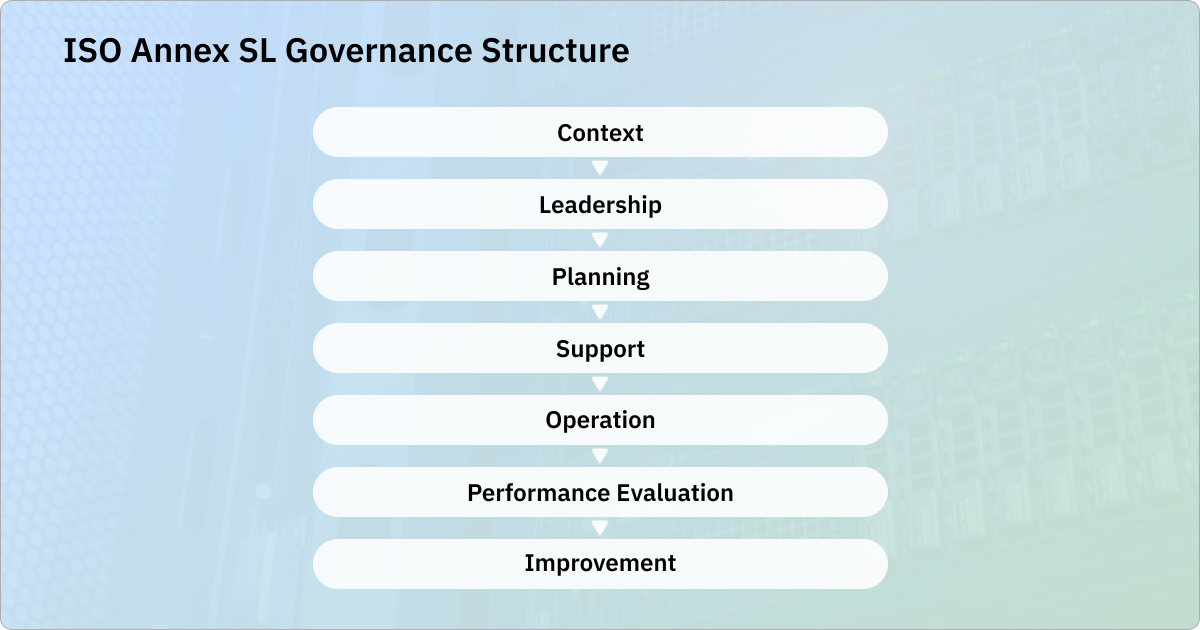
ISO/IEC 42001 provides a structured framework that enables organizations to govern AI responsibly. To promote consistency, it aligns with other management system standards such as ISO 27001 (information security) and ISO 9001 (quality management), and it follows ISO’s high-level harmonized structure (Annex SL), allowing companies to integrate their AIMS into existing management systems.
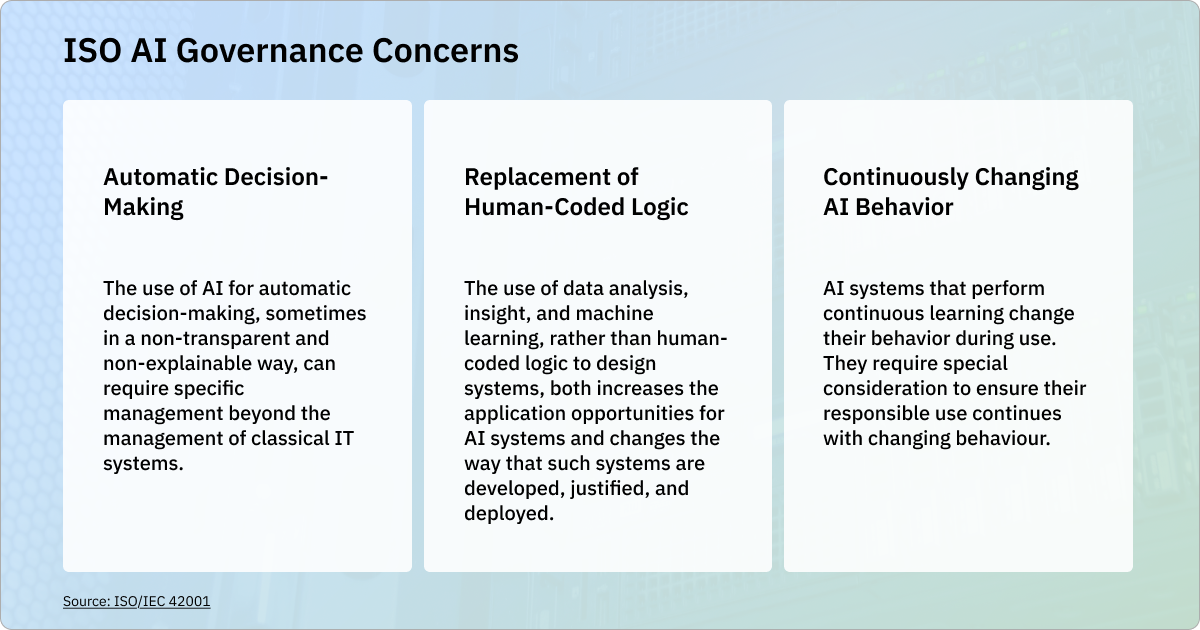
However, ISO/IEC 42001 recognizes that AI introduces distinctive risks (e.g., opacity, bias, autonomy, data dependency, and rapid change) that existing management frameworks don’t fully capture.
Standard-setters designed ISO/IEC 42001 to be more than a set of principles that a company publishes on its website. Organizations are not only required to establish management systems for AI; they have to show that they’re continually improving upon them. They must demonstrate that they have documented policies, assigned accountability, risk-based controls, and objective evidence that the system is working.
ISO/IEC 42001 addresses the full lifecycle of AI, from initial planning and procurement to development, deployment, operation, and retirement. It also aligns with other leading standards for information security, quality, and management systems.
ISO/IEC 42001 alignment with other standards
ISO 27001 - Information Security
ISO/IEC 42001 integrates closely with ISO 27001, extending information security management principles into AI governance. Both standards use a risk-based management system approach, share the Annex SL structure, and include requirements for governance, risk assessment, controls, monitoring, internal audits, and continual improvement. Organizations with an existing Information Security Management System (ISMS) can often reuse many of the same processes and governance mechanisms when implementing an AI Management System (AIMS).
ISO 9001 - Quality Management
ISO/IEC 42001 shares the same management system foundation as ISO 9001, including requirements for organizational context, leadership, planning, operational controls, performance evaluation, and continual improvement. Both standards follow the Plan-Do-Check-Act (PDCA) methodology, although ISO/IEC 42001 applies these principles specifically to the governance, development, deployment, and operation of AI systems.
Annex SL - Harmonized Management Framework
ISO/IEC 42001 follows the Annex SL harmonized management system framework. Annex SL provides the common structure (Context, Leadership, Planning, Support, Operation, Performance Evaluation, and Improvement), terminology, and shared management system requirements that facilitate integration with standards like ISO 9001 and ISO/IEC 27001. This structure enables organizations to incorporate AI governance into existing management systems rather than creating a separate compliance program.
Who does ISO/IEC 42001 apply to?
ISO/IEC 42001 is designed to be used widely. It’s intentionally sector-agnostic and size-agnostic. According to ISO, the standard applies to any organization that:
- Develops AI systems (e.g., software vendors, research labs, in-house engineering teams)
- Integrates AI into products or services (e.g., SaaS platforms, professional services firms, cloud providers)
- Uses AI systems in its operations (e.g., healthcare providers, manufacturers, public sector)
- Manages AI systems provided by third parties (e.g., financial institutions, government agencies)
Examples of in-scope companies might include a hospital deploying a diagnostic imaging algorithm, a bank using credit-scoring models, or a retailer running recommendation engines. Organizations that procure third-party AI systems as part of their supply chain are also affected: the standard calls for consideration of relevant third-party relationships and management of risks from AI systems, products, and services that are sourced externally.
What’s driving adoption of ISO/IEC 42001?
Regulators and stakeholders increasingly expect to see evidence of AI governance.
While application of the ISO/IEC 42001 framework is voluntary, companies will likely face increasing pressure to follow it. Evidence of sound AI governance is rapidly becoming an expectation, thanks in large part to AI regulations taking root in jurisdictions across the globe.
Some key drivers of ISO/IEC 42001 adoption include:
- The EU AI Act, which requires high-risk AI providers to maintain quality management systems with elements that overlap ISO/IEC 42001. Certification to ISO/IEC 42001 does not by itself establish compliance with the EU AI Act
- The UK Government's AI Assurance agenda and the NIST AI Risk Management Framework in the United States, which align conceptually with ISO/IEC 42001's risk-based approach.
- Procurement teams and institutional investors, who are increasingly requesting evidence of AI governance maturity. Third-party certification provides that assurance.
How to implement the ISO/IEC 42001 framework
Enterprises should integrate AIMS into existing management structures.
ISO/IEC 42001 acknowledges that a company’s needs, objectives, processes, size, structure, and stakeholder expectations will all shape how the AIMS is implemented. It also recognizes that companies need to strike a balance between governance mechanisms and innovation. In light of this, the standard allows flexibility to apply the appropriate level of control for specific use cases, services, and products within a company’s scope.
ISO encourages organizations to integrate their AIMS into existing processes and overall management structures. The standard outlines a distinct set of AI-related issues for teams to consider as they design processes, information systems, and controls. These include:
- Determination of organizational objectives, involvement of interested parties, and organizational policy
- Management of risks and opportunities
- Processes for the management of concerns related to the trustworthiness of AI systems, including security, safety, fairness, transparency, data quality, and the quality of AI systems throughout their life cycle
- Processes for the management of suppliers, partners, and third parties that provide or develop AI systems for the organization
Understanding the key components of ISO/IEC 42001
As mentioned above, ISO/IEC 42001 follows the Plan-Do-Check-Act (PDCA) structure common to all Annex SL management system standards. We encourage security teams to think of the structure as an ever-evolving management system rather than a static checklist. In other words, evidence of ISO alignment will come from your documented processes, policies, risk assessments, and records, not just how you technically configure AI systems.
Here’s an overview of some of the core ISO/IEC 42001 sections security teams should get to know (a full list of clauses and descriptions can be found in the ISO/IEC 42001 document):
Context
Before you can design controls, you have to be clear on your specific AI context and risks. For example, if you’re operating in a heavily regulated sector with high-risk AI use cases, you’ll have a broader and more demanding AIMS scope than if you’re just using AI to automate internal processes. For example, a bank building AI for credit decisions needs more rigorous controls than a small company that’s just using AI to draft emails or summarize meeting notes.
There are four key considerations in this section of the ISO guidance:
Organization and Context
You have to determine the internal factors (strategy, culture, technical capability, data assets) and external factors (regulatory environment, competitive dynamics, societal expectations) that could affect your company’s ability to achieve the intended outcomes of the AIMS.
Interested Parties
You need to identify stakeholders with a legitimate interest in your company’s AI activities, including regulators, employees, third parties, and civil society. This can be harder than it sounds. Affected communities that aren’t customers (like job or loan applicants) may still be materially impacted by an AI system, and may therefore need to be considered.
Scope
Your company will need to define which AI systems and organizational units fall within the AIMS boundary. Scope decisions must be justified and documented. In other words, you can’t cherry-pick only low-risk systems to make certification easier. The certification scope can be limited, but its boundaries and applicability must be clear and must not misrepresent what the certification covers.
The AI Management System (AIMS)
This is the key section that calls for organizations to establish, implement, maintain, and continually improve an AIMS in accordance with the requirements of the standard.
Risk Assessment
ISO requires organizations to establish and maintain risk assessment processes that:
- Define risk acceptance criteria before assessments begin (this prevents retroactive rationalization)
- Produce consistent, comparable, and reproducible results
- Identify AI-specific risks across the entire lifecycle
- Evaluate the likelihood and consequence of each risk
- Prioritize risks for treatment
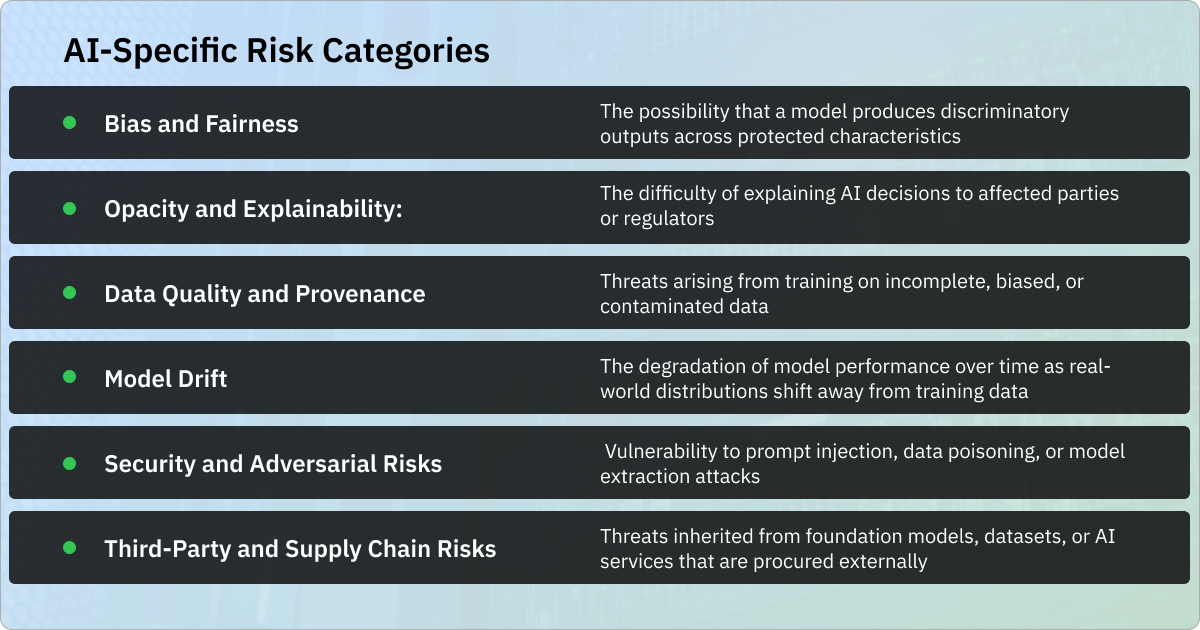
ISO/IEC 42001 requires an AI risk assessment process. Depending on the organization’s context, relevant AI-specific risk categories may include:
- Bias and fairness risks: The possibility that a model produces discriminatory outputs across protected characteristics
- Opacity and explainability risks: The difficulty of explaining AI decisions to affected parties or regulators
- Data quality and provenance risks: Threats arising from training on incomplete, biased, or contaminated data
- Model drift: The degradation of model performance over time as real-world distributions shift away from training data
- Security and adversarial risks: Vulnerability to prompt injection, data poisoning, or model extraction attacks
- Third-party and supply chain risks: Threats inherited from foundation models, datasets, or AI services that are procured externally
ISO/IEC 42001 requires organizations to select appropriate risk treatment options based on the assessment results and determine the controls needed to implement them. Options can include modifying the AI system or its deployment, applying controls, transferring risk where appropriate, or avoiding a use case. The organization must retain documented information about the risk assessment and treatment processes and their results.
Impact Assessment
This is where ISO/IEC 42001 most clearly diverges from conventional IT standards. In addition to requiring internal risk management, the standard asks you to assess the impact of your AI systems on people and society. This reflects the unique potential of AI to affect individuals who have no contractual relationship with the deploying organization.
AI System Impact Assessment (AIIA).
ISO/IEC 42001 requires organizations to define a process for assessing potential consequences for individuals, groups, and society. Depending on the context, that assessment may also consider:
- The intended purpose and reasonably foreseeable misuse of the AI system
- Direct and indirect impacts on individuals, groups, and society
- Impacts across the AI lifecycle, including at decommissioning
- The vulnerability of affected populations (e.g., children, people in financial distress, people with disabilities, and other groups who may be disproportionately harmed)
- Cumulative and systemic effects that may not be visible at the individual-transaction level
The AIIA is distinct from the AI risk assessment, but its results must be considered as an input to that risk assessment. ISO/IEC 42001 requires documented information on the impact-assessment process and its results.
Supplier and Third-Party Relationships.
When AI capability is sourced externally, organizations must assess and manage the risks introduced through that supply chain. Depending on your company’s risk profile, you may use contractual provisions, supplier reviews or audits, and ongoing monitoring.
Documenting AI System Information
You must create and maintain the AI system documentation needed for your role and applicable controls. Depending on the context, this may include the system’s purpose, design, data, performance, limitations, and intended operational environment. These records may support overlapping EU AI Act obligations, but ISO/IEC 42001 certification does not by itself demonstrate EU AI Act compliance.
Continual Improvement
ISO/IEC 42001 is not meant to be a one-time compliance exercise. It requires organizations to continuously improve their AIMS. This is challenging: AI capabilities, threat vectors, regulatory requirements, and public pressures are changing quickly. Your AIMS must adapt to this volatility.
Nonconformity and Corrective Action
When a nonconformity is detected (through internal audit, a model performance incident, a regulatory finding, or a stakeholder complaint), you must react, investigate the root causes, take corrective action, and verify the effectiveness of that action, retaining documented information about the nonconformity, actions taken, and results.
Continual Improvement
The organization must proactively identify opportunities to improve, not merely react to failures. Management review outputs feed directly into improvement planning.
Objectives
AI objectives should be measurable, monitored, communicated, and updated. Progress must be tracked and reported, reflecting the organization's AI risk profile rather than generic aspirations.
Satisfying ISO/IEC 42001's documentation and evidence requirements
The documentation burden for ISO/IEC 42001 can get quite heavy. The standard requires organizations to control the documented information needed for the AIMS and retain evidence of required processes and results. It does not require automation; manual systems can satisfy the standard if the information remains controlled, current, accessible, and auditable.
We recommend you establish a central hub with automated audit trails and policy tracking. Whatever system you use, it should continuously generate evidence and surface any gaps in data or alignment, so auditors can easily see how you’re complying with the standard.
What an Automated Audit Trail Can Support
Documented information should be controlled. That means it must be identifiable, accessible, protected against unintended alteration, and retained for defined periods. If you use automation, an audit trail can provide:
- Sealed, decision-time records. Every enforcement decision (an allow, a redaction, a hold, a block) should be recorded the moment it's made, capturing the surface it ran on (app, gateway, API, agent, or endpoint), the actor involved, the class of data or threat detected, the policy and version applied, the action taken, and an integrity mechanism so the record can be verified later. Whether raw prompts or outputs are retained should be governed by data-minimization, security, privacy, legal, and audit requirements; ISO/IEC 42001 does not mandate a metadata-only approach.
- One trail across every surface. AI activity typically spans multiple deployment surfaces: a sanctioned application, a gateway, an API, an autonomous agent, an endpoint. For an inventory that covers multiple AI systems, these should feed a single evidence chain rather than fragmented logs that you’ll have to manually reconcile across tools.
- Linked evidence for impact assessments. If an AIMS claims that AI systems undergo impact assessment before deployment, an assessor should be able to see the actual assessment records tied to each in-scope system, with dates, approvers, and outcomes visible, not just a policy document asserting that they happen.
- Integration with existing security infrastructure. Records should be able to stream to the SIEM platforms you already use, so AI governance evidence sits in the same pipelines auditors and SOC teams already trust, rather than living in an isolated compliance tool that no one else has access to.
- Mapping to the assessor's control language. Enforcement activity should be organized in the language of the specific controls it addresses, so that a single enforced policy can be shown as evidence toward the requirements it serves.
- Reports assembled from existing records. Compliance reports should be filterable by time range, department, user, model, or policy, and drawn from records that already exist rather than reconstructed. When an internal auditor, external assessor, or the board asks a question about a period of AI activity, you should be able to pull a filtered report, not launch a time-consuming collation project.
- Always current records. Evidence should accrue with every governed interaction, so the report you generate shows current activity, not a point-in-time assessment that's already gone stale.
Getting started: A practical roadmap for ISO/IEC 42001 certification
If you’re pursuing ISO/IEC 42001 certification for the first time, our advice is to think of it as a critical governance and security exercise, not just a box to check for regulators. If you do it well, you’ll end up with a strong AIMS that will ultimately make your company more resilient.
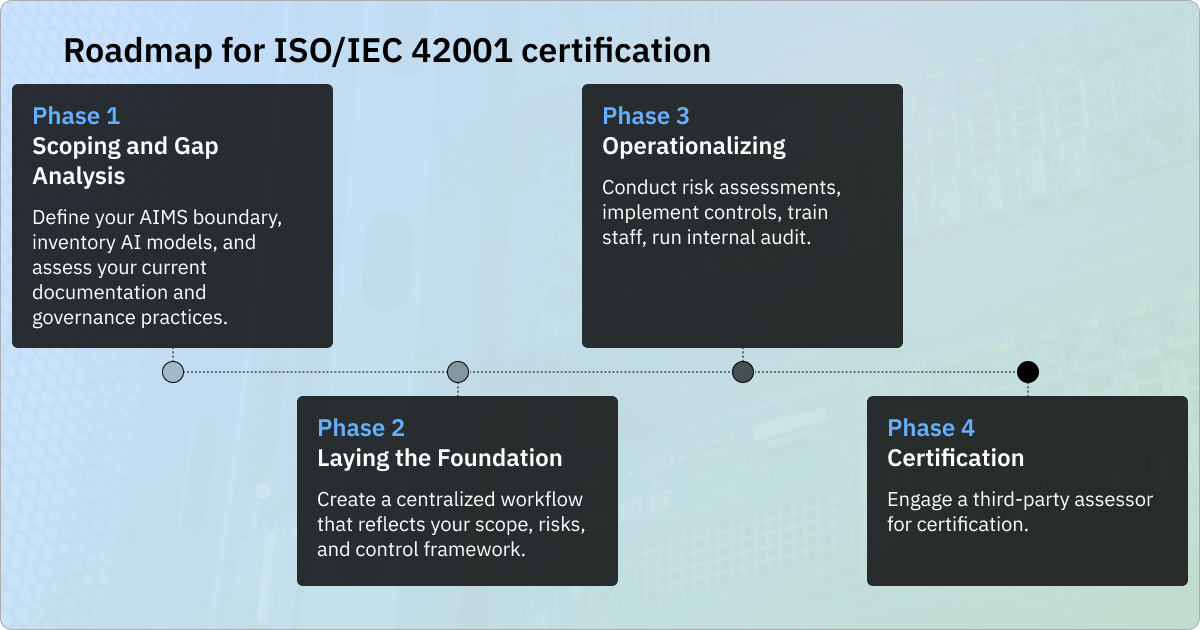
To get started, it can be helpful to break the process down into four phases:
Phase 1: Scoping and Gap Analysis
- Download the full ISO/IEC 42001 standard and get familiar with the requirements.
- Define your AIMS boundary, inventory your in-scope AI systems, and assess your current documentation and governance practices against each ISO/IEC 42001 clause.
- This gap analysis will turn into your project plan. A system built around structured, mapped enforcement records makes the gap analysis faster and more accurate.
Phase 2: Laying the Foundation
- Clarify your AI governance policy and assign roles and responsibilities.
- Design your risk and impact assessment methodologies.
- Establish your compliance and evidence management systems.
Phase 3: Operationalizing
- Conduct risk and impact assessments for all in-scope AI systems.
- Implement and record your controls.
- Complete training and awareness for staff.
- Run the first internal audit cycle. Your audit trail should link directly to evidence. Where automated evidence collection is used, records can generate continuously, with policy enforcement captured when it happens.
Phase 4: Certification
- Address internal audit findings through corrective action.
- Engage an independent certification body to conduct the certification audit. Note that independent certification bodies, not ISO, are responsible for certification.
First Recon AI helps streamline the path to ISO/IEC 42001 compliance
Starting with the right tools will make ISO/IEC 42001 certification far easier. First Recon AI is an all-in-one secure AI workspace that builds in reporting and compliance. It applies security and governance controls to AI interactions that travel through supported applications, gateways, APIs, agents, and integrations so your organization can adopt AI quickly. It’s not just a security and compliance layer added on; it is the secure environment: employees can chat, manage agents, run tasks, and access company knowledge, with audit trails and compliance integrated all along the way.
First Recon’s AI Security Runtime records every enforcement decision for supported, governed interactions and organizes the evidence in the control language used by ISO and major AI compliance frameworks, so reports and audit documentation are ready to go when you need them. You get:
Reports on demand
Compliance reports filtered by framework and time range, assembled from the trail, not from a scramble.
Framework mapping
AI activity organized in the control language your auditors use.
Evidence as you run
Every enforcement decision recorded the moment it is made; the trail accumulates as your organization uses AI.
Supported surfaces, one trail
App, gateway, API, agent: one evidence chain, human or agent.
SIEM-ready export
Evidence streams in real time to the pipelines your SOC and auditors already trust.
Separate security record
The audit record stores the decision and its context without duplicating prompt or response bodies.
Instead of spending hours assembling evidence after you get a question from an auditor or your board, you can use records that already exist. You’ll have a sealed, metadata-only decision receipt for each recorded enforcement decision on a governed path: the surface, the actor, the detection class, the policy and version, and the action taken.
Talk to our team or schedule a demo to see how First Recon AI can help simplify your ISO/IEC 42001 certification process.
Moving from aspiration to action
No matter what industry you’re in, you’ll likely be asked about ISO/IEC 42001 soon, if you haven’t been already. Pursuing certification shows that you’re moving from intentions to concrete action. Instead of just saying “we’re committed to responsible AI use,” you should be able to describe the exact system you use for managing AI risk (and show that it works).
The goal isn’t just to check a certification box. Aligning with the ISO framework is a chance to build an AI management system that will help you keep the ship steady as new AI models, regulations, and security concerns proliferate.
Frequently Asked Questions (FAQs)
Is ISO/IEC 42001 mandatory?
No. It is a voluntary standard created by international standard-setters. However, some AI regulations include overlapping requirements, and companies face increasing pressure to demonstrate structured AI governance. ISO/IEC 42001 certification does not replace a separate legal assessment.
Why is ISO/IEC 42001 important?
ISO/IEC 42001 is the world's first AI management system standard. It provides valuable guidance to help organizations navigate the distinct challenges raised by AI, including ethical considerations, transparency, and continuous learning.
Does ISO provide certification for 42001?
No. ISO does not certify organizations. Certification is carried out by independent certification bodies, which may be accredited by national accreditation bodies.
Who is ISO/IEC 42001 designed for?
The standard is for organizations of any size that develop, provide, or use AI-based products or services. It applies across a range of industries, public sector agencies, and non-profits.
Which AI systems does ISO/IEC 42001 cover?
The standard is designed to be applicable across a variety of AI applications and contexts. An organization still defines the boundaries and applicability of its AIMS and certification scope.
What is an AIMS?
An AI Management System (AIMS) is a set of policies, objectives, and processes that relate to the responsible development, provision, or use of AI systems.
Why are companies implementing ISO/IEC 42001?
Companies are facing increased pressure from regulators, investors, customers, and others to apply the standard. Alignment builds trust in AI applications, can support broader legal and regulatory compliance efforts, helps teams manage AI-specific risks, and encourages innovation within a structured framework.
How does ISO/IEC 42001 differ from other ISO AI standards?
While ISO has published other standards to address AI, 42001 is a standard specifically for management systems. It requires organizations to implement policies and procedures for the sound governance of AI use.