The security industry spent decades building tools to protect an enterprise’s networks, endpoints, data, and identities, all with the assumption that work was being done by humans. AI has flipped that assumption, and traditional security approaches alone are no longer enough. It's not enough to have a firewall if an agent can be redirected by instructions embedded in a web page, and network traffic logs alone may miss sensitive data shared through AI conversations rather than file transfers.
Enterprise AI security platforms are built for this new terrain. They deliver AI-specific threat detection, data protection, governance, and identity controls, helping security teams close the gap between AI adoption and risk management.
In this article, we’ll discuss why companies are investing in enterprise AI security platforms, the features to look for, and the leading products on the market today.
Why is the enterprise AI attack surface different?
AI is a target and an attack vector.
AI has expanded the enterprise attack surface in ways that are qualitatively different from previous technology shifts.
AI is both a target and an attack vector. Adversaries are using AI to attack organizations faster and at greater scale. At the same time, the AI systems enterprises deploy create attack surfaces themselves. They’re susceptible to prompt injection, model manipulation, data poisoning, and other threats that conventional security tools weren't designed to detect. Here’s a look at some core vulnerabilities AI introduces:
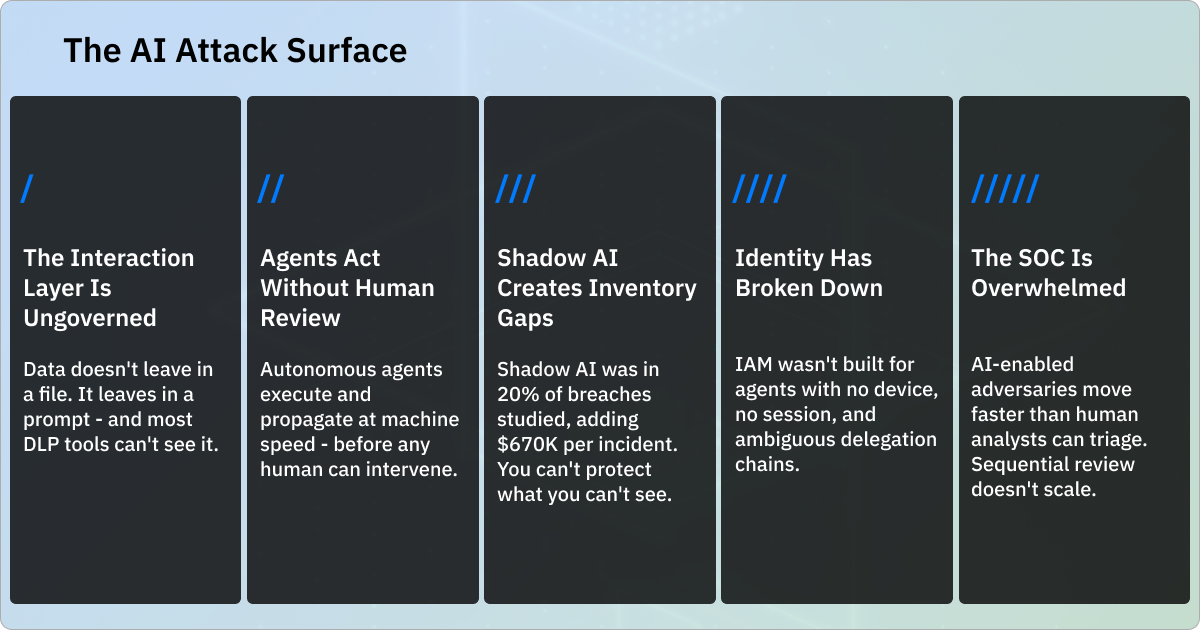
The interaction layer is ungoverned.
Every AI conversation is a potential data channel. Employees paste confidential documents, customer records, and financial projections into AI tools daily, often without organizational visibility and without DLP tools capable of scanning for meaning and intent.
Agents can act without human review.
Autonomous agents can execute code, query databases, send communications, and call external APIs at machine speed, sometimes without the delays that traditionally created opportunities for human oversight. When something goes wrong, the problem can propagate across connected systems before anyone notices.
Shadow AI creates inventory gaps.
Governance, risk management, and security all require knowing what's in the environment. As employees adopt AI tools independently, organizations lose the visibility that every other security function depends on. You can't protect what you don't see. One report analyzed 600 organizations that had experienced a breach. One in five reported a breach involving shadow AI, and organizations with high levels of shadow AI had an average of $670,000 in additional breach costs.
Identity has broken down.
AI agents need credentials to function, but identity systems weren't built for entities that operate continuously, at scale, across multiple systems simultaneously. Static permissions, shared service accounts, and standing privileges create exposure that conventional IAM tools weren't designed to address.
The SOC is overwhelmed.
The model of security operations built on human analysts reviewing alerts sequentially does not always scale to current alert volumes. The volume of alerts has outpaced security teams’ capacity to triage. AI-enabled adversaries can move faster than humans can respond.
Features to look for in an enterprise AI security platform
Start by identifying where you’re most exposed.
AI security platforms are responding to a moving target. The features that matter today are different from the ones that mattered last year, and the ones that will matter in eighteen months. When you’re assessing options, it’s helpful to start by identifying where you’re most exposed now. Choose a platform that addresses that critical need and allows for adaptation as models and security risks evolve. Here’s our list of the core features you should look for:
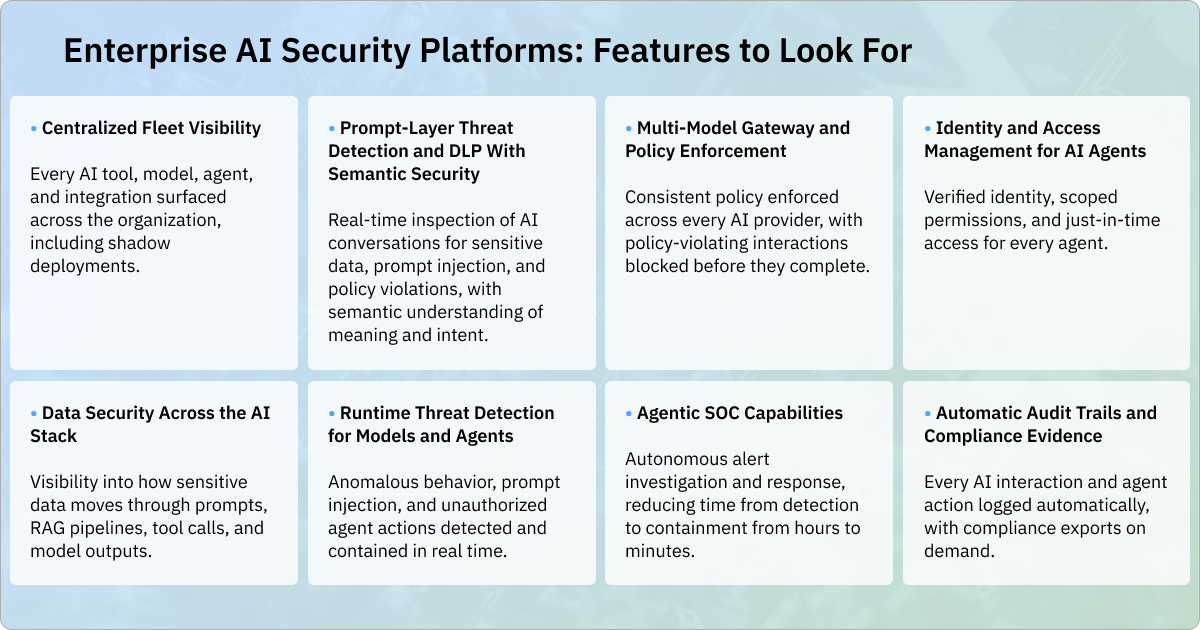
1. Centralized fleet visibility
Your platform should surface the AI tools, models, agents, and integrations it can discover across supported endpoints, browsers, SaaS applications, and cloud environments, including shadow AI. Visibility is the prerequisite for every other security function.
2. Prompt-layer threat detection and DLP with semantic security
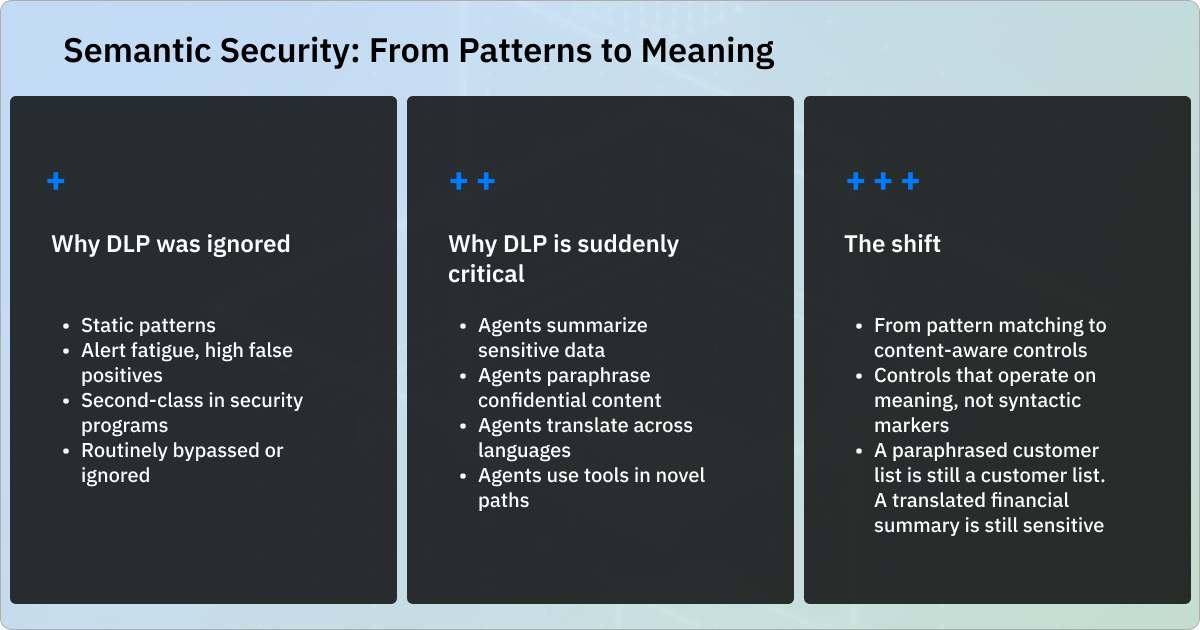
It’s essential to have real-time inspection of AI interactions for sensitive data, prompt injection, jailbreaks, and policy violations. Traditional DLP tools can inspect files and traffic, but AI use also requires real-time inspection of conversations and model outputs at the interaction layer. Look for a platform with AI-native semantic security that analyzes the meaning, context, and intention of an AI interaction, rather than just detecting patterns.
3. Multi-model gateway and policy enforcement
Look for systems with a control plane that governs which models and AI services employees and agents can access, enforces consistent policy across providers, routes requests based on governance rules, and blocks interactions that violate policy before they complete.
4. Identity and access management for AI agents
Every agent should require a verified identity, scoped permissions, and a revocable credential. Agents should operate under least-privilege access, with just-in-time permissions for specific tasks rather than standing access to systems they may or may not need.
5. Data security across the AI stack
Sensitive data flows through AI systems in ways that traditional DSPM and CASB tools weren't built to track (through prompts, RAG pipelines, agent tool calls, and model outputs). Data security for AI requires visibility into how data moves through the AI interaction layer, not just how it moves through the network.
6. Runtime threat detection for models and agents
Your platform should offer behavioral monitoring that detects anomalous model behavior, prompt injection attempts, adversarial manipulation, and unauthorized agent actions in real time and can block or contain them while they're happening rather than surfacing them in post-incident review.
7. Agentic SOC capabilities
AI-native security operations that use agents to investigate alerts and execute response actions autonomously can shorten the time between detection and containment.
8. Automatic audit trails and compliance evidence
Relevant AI interaction metadata, agent actions, and policy enforcement decisions should be automatically logged with enough detail to reconstruct incidents, support audits, and collect evidence for applicable requirements and frameworks, including the EU AI Act, NIST AI RMF, and SOC 2.
The 7 best enterprise AI security platforms in 2026
The attack surface is expanding faster than most security programs were built to handle, and the platforms responding to it are doing so from different starting points, with different architectural assumptions about where the most critical gaps are. Here’s a review of leading platforms on the market, in no particular order:
Palo Alto Networks Prisma AIRS
Palo Alto Networks launched Prisma AIRS 3.0 in March 2026, positioning it as a platform to secure the entire agentic AI lifecycle from development through runtime execution. Palo Alto Networks’ premise is that AI risk doesn't live in a single layer. It spans the AI supply chain, where compromised models and agent code shape behavior; posture risks, where overpermissioned agents operate across environments; and runtime, where behavior can be redirected mid-task.
Development-time security scans agent code, configurations, and tool integrations before deployment. An AI Runtime Firewall inspects traffic for prompt injection, sensitive data leakage, and model denial-of-service attacks. AI asset discovery inventories agents, models, and connections across supported cloud, SaaS, and endpoint environments. Palo Alto Networks’ 2026 acquisition of Portkey established an AI Gateway as a centralized control plane to monitor, orchestrate, and govern agent interactions at scale: routing requests to appropriate models, enforcing consistent policy, and logging token usage for cost attribution.
Best for: Large enterprises with existing Palo Alto Networks infrastructure that need end-to-end AI security integrated with their network, cloud, and SASE stack, particularly those where the top concerns are supply chain integrity, AI inventory, and runtime enforcement across cloud-hosted models.
First Recon AI
First Recon AI takes a novel approach to enterprise AI security. It offers a single platform for governance, security, and productivity. Rather than adding a layer of oversight to the AI environment, First Recon AI provides the AI environment; it’s a secure workspace where employees can engage safely with major AI models and agents supported by the platform, including ChatGPT, Claude, Gemini, Copilot, and others.
On governed paths, nothing reaches a model without passing the AI Security Runtime . It reads each prompt, response, and agent action, looking at meaning, intent, who is asking, and which policy applies. It then allows, redacts, holds, or blocks the action. It traces every decision as metadata-only evidence, ready for SIEM pipelines and organized against the compliance frameworks configured for the organization. SIEM integration and compliance exports then make that evidence available to external systems and reviewers.
First Recon AI’s key innovation is its Semantic Security Engine . Unlike traditional cloud and network DLP tools, which work by recognizing patterns, the semantic security engine understands meaning and context, so it can identify sensitive information even when it doesn’t match a predefined pattern.
You can try these features out with First Recon’s free 30-day trial.
Best for: Enterprises of all sizes and sectors where multiple AI models are already in use, and where rapid, secure deployment of AI capabilities is a priority.
Microsoft Agent 365 and Security Copilot
Microsoft's approach to enterprise AI security runs through the company’s widely used infrastructure. Microsoft positions Agent 365 as the enterprise control plane for AI agents, alongside network-level prompt injection protection and shadow AI discovery.
Security Copilot supports security workflows across Microsoft Defender, Entra, Intune, and Purview, including phishing triage, identity threat detection, and data security investigations, and surfaces findings and recommended actions to analysts. Through Microsoft Entra Agent ID, Microsoft extends identity and access controls to AI agents, including conditional access, lifecycle governance, and least-privilege access.
Microsoft Purview captures prompts, responses, and audit information for supported Copilot and Agent 365 interactions, providing records of AI activity. In April 2026, Microsoft also released an open-source Agent Governance Toolkit, which addresses 10 OWASP agentic AI risks.
Best for: Enterprises with Microsoft 365, Azure AI, and Copilot deployments that need AI security to extend naturally from existing endpoint, identity, and compliance infrastructure.
Unseen Security
Unseen Security was designed to solve the problem of Shadow AI. The platform uses network and gateway controls to inspect AI interactions across supported tools, including ChatGPT, Copilot, and Claude. This provides content-level visibility into what employees send through governed access paths rather than only logging traffic to known domains.
When employees visit Shadow AI tools, they're automatically redirected to a governed platform. The Secure AI Gateway gives employees a single interface for ChatGPT, Claude, Gemini, and other leading models, with model training disabled for interactions routed through the gateway. Policy enforcement lets security teams define rules by data type, department, and model, with real-time DLP blocking sensitive content before it reaches an external model. Pay-per-use pricing replaces per-seat licensing, letting organizations give every employee access to enterprise-grade AI rather than rationing access to power users while leaving everyone else to turn to free Shadow AI tools. Compliance alignment templates cover DORA, GDPR, the EU AI Act, HIPAA, and SOC 2.
Best for: Organizations whose most pressing AI security problem is Shadow AI and who need network-level visibility and governed multi-LLM access without replacing existing security infrastructure.
7AI
7AI uses AI agents to transform enterprise security. The platform deploys autonomous agents across telemetry from endpoint, identity, cloud, email, network, and threat intelligence sources. Agents can autonomously investigate alerts, enrich data from multiple sources, correlate signals across disparate systems, and generate investigation conclusions, with humans on the loop for escalations and response.
Dynamic Reasoning allows 7AI agents to address novel threats by determining their investigative approach in real time. The 2026 launch of Threat Hunt, Threat Intel Hunt, and Skills extended the platform’s capabilities, from reactive alert investigation to proactive threat hunting, letting security teams trigger investigations from any intelligence source and configure agent behavior to match their environment and expertise.
Best for: Enterprise security operations teams managing high alert volumes who need AI-native investigation and response automation to keep pace with AI-accelerated adversaries.
Symmetry Systems AI Guard
Symmetry Systems positions itself at the intersection of data security and AI security. Its premise is that what AI systems can access and expose is ultimately a data security problem, and that solving it requires understanding the relationship between identities, permissions, and data across the entire enterprise environment.
In February 2026, Symmetry launched AIGuard, a standalone AI security and governance platform that provides visibility, governance, and control across external LLMs, enterprise copilots, internal AI services, and agentic AI identities. The platform's core infrastructure is an Identity x Data Graph, a continuous map of relationships among identities (human and AI), permissions, and data assets across connected environments. AIGuard is designed to surface risky agents: over-privileged agents, agents accessing sensitive data, agents with destructive capabilities, orphaned agents with no identifiable owner, and dormant agents that retain permissions despite inactivity. Internal AI services (predictive, generative, and RAG-based) are inventoried by type, environment, and instance, with a core set of governance questions answered for each.
Symmetry extends coverage to cloud, SaaS, hybrid, and legacy on-premise systems, including IBM AS/400, DB2, and Nutanix. This includes air-gapped environments, which may be important for large enterprises where critical data still lives in legacy infrastructure. In May 2026, cybersecurity platform Zscaler announced plans to acquire Symmetry Systems.
Best for: Large enterprises with complex, hybrid data environments, especially those building or deploying internal AI services.
CrowdStrike Falcon
In 2026, CrowdStrike announced new Falcon platform capabilities that extend AI agent discovery, shadow AI governance, and runtime threat detection directly from the endpoint across SaaS, browser, and cloud environments.
Falcon Data Security stops data theft in real time across endpoints, browsers, SaaS, cloud, and AI workflows. Falcon for IT identifies AI tools, agents, models, SDKs, and frameworks, including shadow AI that traditional tools might miss. CrowdStrike has announced Continuous Identity for AI Agents, a capability designed to provide identity governance for agents by replacing static policies and standing privileges with real-time, risk-aware access controls. CrowdStrike’s agent, Charlotte AI AgentWorks, enables security teams to build, test, and deploy custom security agents using no-code tools, with integrations for Claude, ChatGPT, NVIDIA Nemotron, and AWS Bedrock. The Falcon AIDR ecosystem now extends across AI gateway partners, including Databricks, Google Cloud, Microsoft Azure, Kong, and LiteLLM, giving the platform visibility across the AI interaction layer where prompts and agents operate.
Best for: Regulated organizations running the Falcon platform that want AI security integrated directly into existing endpoint, identity, and SIEM infrastructure.
Building security into the AI stack
The security perimeter has moved. It now extends into every AI interaction, every agent action, and every model that touches your data. To respond, you need security tools designed specifically for the new risks arising from AI. Putting the right guardrails in place is the first step in scaling AI and taking full advantage of its capabilities, so your employees can not only increase their productivity, but do work that was previously impossible.