For most of the history of enterprise security, access control has been a human problem. You provisioned users, assigned roles, reviewed permissions on a schedule, and deprovisioned accounts when employees left. The process was slow and imperfect, but it worked in a world where people were the ones accessing systems.
AI agents complicated that assumption. Non-human identities, a category that includes service accounts, applications, devices, automation, and AI agents, now outnumber human identities by as much as 80 to 1. Agents access financial data, customer records, SaaS applications, code repositories, and critical infrastructure. They can act autonomously at machine speed, often without clear ownership and with inherited or overly broad permissions that were not scoped to the task.
We’re in a new world now, and we need new tools. In this article, we’ll cover what’s driving the AI access control problem, features to look for in an access control tool, and the leading solutions on the market today.
What’s driving the AI access control problem?
The access control problem created by AI is beyond the scope of traditional management tools.
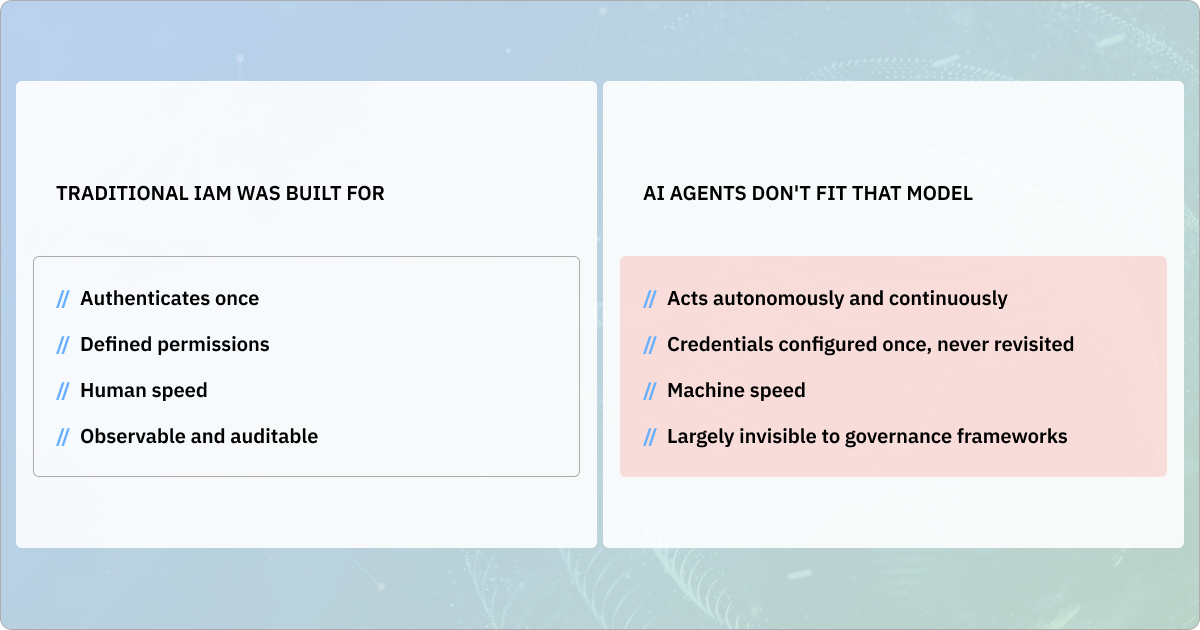
Access control is a pressing concern for security teams. Traditional IAM was designed around a predictable model: a human employee authenticates, receives a defined set of permissions, and accesses resources in ways that are largely observable and auditable. AI agents don't fit that model: They can act autonomously, spawn sub-agents, and access multiple systems simultaneously.
They also move fast. Governance frameworks based on quarterly access certification cycles, static role assignments, and IT help desks were designed for a workforce that acts at human speed. AI agents can execute hundreds of actions, access dozens of systems, and interact with external APIs before a human analyst receives the first alert.
Forces Driving the AI Access Control Problem
Overpermissioned Agents
Agents often operate under credentials that were configured quickly, reviewed loosely, and never revisited. A customer service agent with access to billing data or HR records creates an attack surface that grows with every new task it's assigned. When that agent is compromised or manipulated through prompt injection, the blast radius is determined by what it was permitted to reach, not what the task required.
Unclear Ownership
Agents are deployed by employees in many different departments. Without a centralized inventory, security teams have no reliable view of the agents that exist, who owns them, or what access they hold.
Machine Speed Actions
Access review systems were designed for a human pace. Quarterly certifications and IT tickets can’t keep up with entities that can execute hundreds of actions before a human analyst is alerted.
Regulatory Pressure
The EU AI Act includes obligations for certain AI systems and their providers or deployers. GDPR and HIPAA are not AI-specific laws, but their privacy and security requirements may apply when AI systems process covered data. Access governance can therefore support both security and compliance, depending on the system, data, and jurisdiction.
Features to look for in an AI access control tool
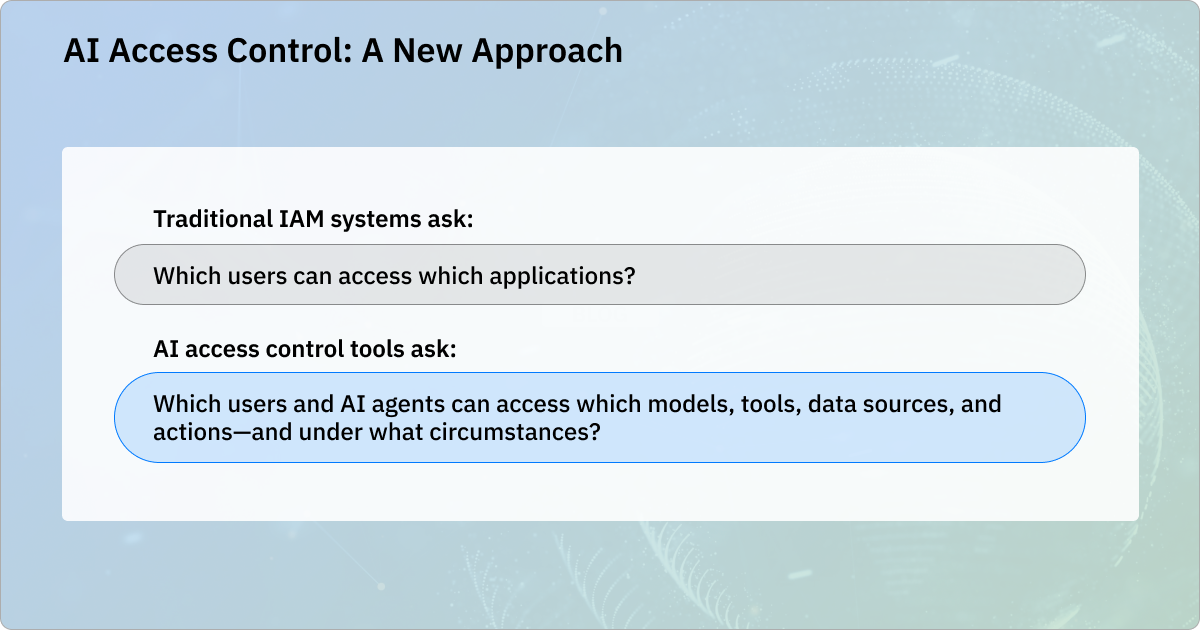
Most enterprises already have identity and access management infrastructure in place. But organizations need a different set of solutions to deal with AI agents that authenticate and behave differently than humans. Here are the key features to look for in an AI access control tool:
AI Agent Discovery and Inventory
Your platform should continuously surface agents across supported, connected environments, including shadow agents deployed without IT involvement. A centralized inventory that captures agent identity, ownership, purpose, and current permissions is the baseline for everything else.
Session-Based Access Control
AI interactions should be independently verified per session, with context-aware policies adapting to user role, data sensitivity, model type, and interaction risk rather than relying on static allow lists. Agents should receive the minimum access required for a specific task, with permissions scoped to what the task actually requires.
Traceability and Audit Trails
You should be able to trace agents back to their origin. Every action, credential use, and access decision should generate tamper-evident audit records with policy decision evidence, policy versioning, and exports that support SOC 2, HIPAA, and GDPR obligations.
Real-time Monitoring
Access controls set at deployment time don't account for how agent behavior evolves. The platform should monitor agent actions in real time and allow for dynamic, contextual access decisions.
Contextual Security
The same content can be safe for one actor and scenario, and dangerous in another. Your security tool should be able to tell the difference. Look for a tool that can connect prompts and actions to their context: the identity, device, data, destination, policy, and history.
Top 5 AI Access Control Tools in 2026
Access control isn’t a problem you can solve once and move on from. Every new agent deployment and model integration adds to the attack surface. Access control tools are evolving in response. Here’s a look at the capabilities of leading solutions on the market today (in no particular order). These products are not direct substitutes: some focus on non-human identity governance, while others govern AI interactions, agent actions, or broader security controls.
Oasis Security
Oasis Security was built to address the visibility, security, and governance of non-human identities (NHI) across hybrid cloud environments, automatically discovering NHIs, assessing their risk, and identifying owners using AI-based analytics, with integrated policy-driven governance across the full NHI lifecycle.
Oasis Agentic Access Management, introduced in November 2025 and updated in May 2026, extends that foundation to govern AI agents acting on top of the NHI infrastructure Oasis already manages, from underlying service identities through to the AI agents employees use every day. The core mechanism is intent-aware, just-in-time access: Oasis identifies what an agent is trying to do, breaks it into a precise action plan, determines exactly the access required, and issues ephemeral per-session identities scoped only to that action, eliminating standing privileges and minimizing blast radius. Each prompt is bound to a unique identity for complete traceability.
Every session generates a complete chain of custody (human, agent, prompt, intent, policy, identity, actions, and results), providing visibility and accountability, with regulator-ready evidence for AI governance. The platform continuously discovers unauthorized tools, NHIs, and unmonitored agent activity across the enterprise. It enforces least privilege, isolates AI access, automates provisioning and rotation, and restricts AI agents to approved model suppliers while tracking how enterprise data is accessed or shared. Oasis covers AI agents and non-human identities across IaaS, SaaS, PaaS, and on-premises environments, including AWS, Azure, BigQuery, GitHub, ChatGPT, Salesforce, Office 365, and Copilot.
Best for: Enterprises where access control is a top concern, particularly those that need an audit trail and complete chain of custody from human to agent to action.
First Recon AI
First Recon AI approaches the access control problem from a structural perspective. It brings the sprawl of AI into one secure, governed productivity workspace. This allows teams to manage access at the interaction layer while retaining identity context.
Employees create, share, and run agents in First Recon’s Agent Hub so that they can do real work with company data at machine speed. AI Security Runtime governs agent actions that run through supported paths: each tool call, data read, and handoff is evaluated with identity, data, and destination attached, then allowed, redacted, held for human review, or blocked before execution.
The Security Context Graph connects each prompt and agent action to the identity, device, data, destination, policy, and decision history that govern it, before the interaction proceeds. Security decisions incorporate the organization’s context and relevant decision history. The same policies serve every governed surface, which means the same situation gets the same decision in chat, agents, and knowledge queries. Organizations can start with a library of out-of-the-box policies they can tailor for their industry, sector, geography, and compliance frameworks.
First Recon AI also streamlines compliance. When an agent acts, it leaves a record: who the agent was acting for, what it tried, which policy judged it, and how the decision landed. If a held action was released, the record names who released it. Each enforcement decision generates a structured audit record, with evidence organized against the compliance frameworks configured for the organization.
Security teams can test First Recon’s access control tools through a 30-day free trial.
Best for: Enterprises where AI is already in use across different models, and productivity, AI access control, and security are all high priorities.
SailPoint Agentic Fabric
SailPoint launched Agentic Fabric in May 2026, extending its Identity Security Cloud model to cover AI agents and nonhuman identities operating alongside human employees.
Agentic Fabric is structured around three functions: “Discover” surfaces every AI agent across cloud environments, applications, and endpoints (including shadow deployments). “Govern” maps every agent to human ownership and human identity context while managing lifecycle controls and access policies. “Protect” enforces real-time controls for authorization with threat detection and automated response to maintain least-privilege access as agents act.
New connectors for SailPoint Agent Identity Security can discover and govern AI agents from platforms including Microsoft 365 Copilot, Databricks, Amazon Bedrock, Google Vertex AI, Microsoft Foundry, Salesforce Agentforce, ServiceNow AI Platform, and Snowflake Cortex AI. Two governance tiers address overpermissioning directly: Agentic Business enforces least-privilege access across all identity types, while Agentic Business Plus advances to zero-standing privilege, meaning agents receive just-in-time access for specific tasks rather than persistent permissions between uses.
In June 2026, SailPoint completed its acquisition of Entro, a nonhuman identity security company. The acquisition adds proprietary Nonhuman Identity Detection and Response capabilities, allowing SailPoint customers to continuously monitor AI agents and machine identities for behavioral anomalies in real time, expose over-privileged access, enforce least privilege, and automate threat mitigation at machine speed.
Best for: Organizations with mature identity governance programs that need to extend IAM to AI agents within the same framework they apply to human identities.
Palo Alto Networks
Palo Alto Networks approaches AI access control as a platform problem spanning three distinct surfaces: the employee, the application, and the agent. For employee AI usage, it enforces granular access controls and data loss prevention inline, blocking sensitive text and file transfers to both sanctioned and unsanctioned tools while coaching users in real time when they approach a policy boundary.
For AI applications built internally, it provides a runtime firewall that inspects prompts and responses, alongside automated red teaming capabilities that test applications against attack types before they reach production. For autonomous agents, Prisma AIRS 3.0, launched in March 2026, introduced an AI Agent Gateway that became generally available in July 2026. For traffic routed through the gateway, agent interactions can be identified, authenticated, and authorized in real time, with tool calls, model access, and external connections governed through centralized policy. Agent identity security is enforced through Idira, the company’s identity security platform built on CyberArk’s technology following the acquisition, which applies zero standing privilege and just-in-time access to every human, machine, and agentic identity across the enterprise. The three layers are designed to operate as one platform rather than three coordinated point products.
Best for: Large enterprises that are already in the Palo Alto Networks ecosystem and need AI access control unified across the employee, application, and agent layers.
CrowdStrike
In June 2026, CrowdStrike announced Continuous Identity for AI Agents, a new Falcon Next-Gen Identity Security capability. It’s designed to address what the company describes as the fundamental breakdown in legacy access models: As AI agents operate with superhuman speed and access, static policies and standing privileges grant access without context and remain blind to real-time risk.
Continuous Identity for AI Agents authorizes every agent action in real time based on who owns the agent, who is calling it, and the risk posture of the device involved, evaluated against native and third-party risk signals on the Falcon platform. Each agent is assigned a cryptographically verifiable identity based on the SPIFFE standard, replacing static credentials such as API keys with automated, secure workload identities. Access is dynamically granted, denied, and revoked as conditions change rather than persisting as standing access.
Falcon Shield automatically discovers and classifies AI agents across connected SaaS platforms, maps available information about who created each agent, which users have access to it, what data it can access, what actions it can take, and where it is deployed. It detects unauthorized agents and flags risky configurations, including internet exposure, over-permissioning, and access to code repositories, correlating each agent's privileges to its associated human or service identity. Falcon AIDR complements Continuous Identity by continuously inspecting prompts and intent to detect permission misuse or attempts to manipulate an LLM beyond its authorized scope, triggering Continuous Identity to revoke access before damage is done. Coverage spans initial access, privilege escalation, and lateral movement across on-premises, SaaS, browser, and cloud environments.
Best for: Organizations already running CrowdStrike Falcon across endpoint, identity, and cloud that want agent access control unified with the same threat intelligence and risk signals governing the rest of their security stack.
Rethinking access control
AI access control continues to come up in conversations about security. IT teams now have to rethink how they approach identity. They need tools that allow them to continuously govern access, both human and nonhuman. Establishing reliable access control infrastructure early on will put your organization in a stronger position to scale AI use, so your employees can not just use AI to work more efficiently, but to do work that was previously impossible.