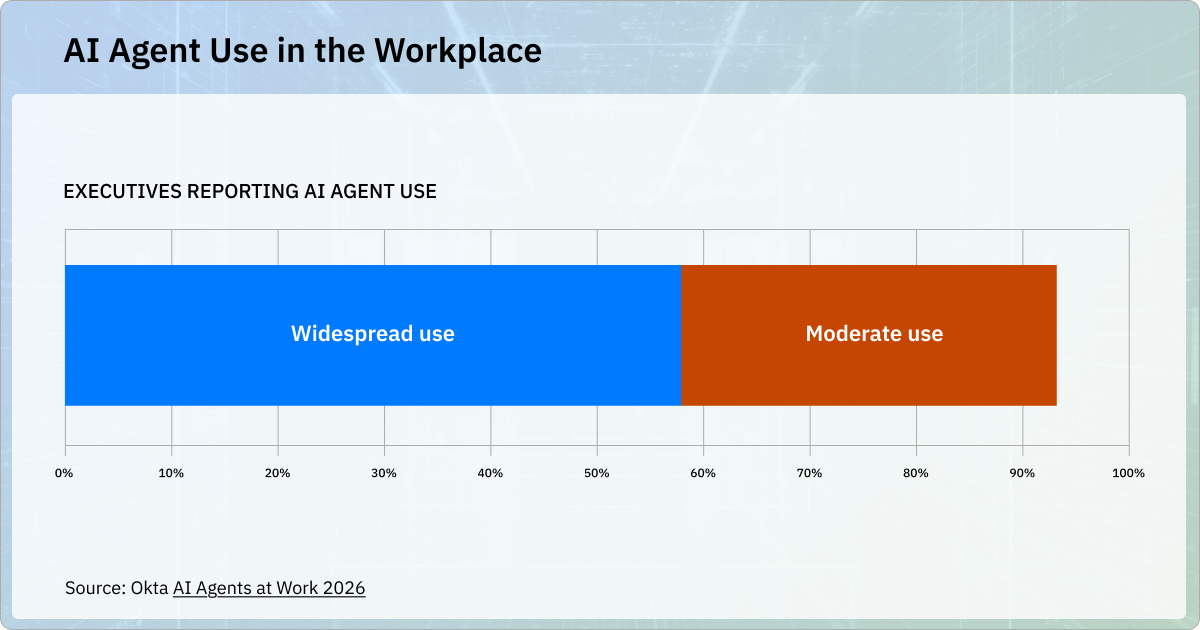
AI agents are proliferating at a lightning pace. In a 2026 Okta survey of 292 executives and 492 knowledge workers, 92% of executives reported that agents were already in widespread (58%) or moderate (35%) use within their companies. Among the surveyed knowledge workers, all of whom had used AI in the previous three months, agents were the most popular AI tool, used by 68% (compared with 62% for LLMs). As they grow in popularity, agents are opening the door to a new suite of risks and scrutiny.
For the most part, governance hasn’t caught up. Nearly two-thirds of enterprise security leaders in the study above said they apply weaker security controls to agents than human employees, even though agents may be granted access to the same sensitive data and internal systems.
In this guide, we take a look at the specific governance challenges raised by AI agents, the features to look for in an AI agent governance platform, and the leading products on the market today. AI agent governance differs from broader model governance because it focuses on agent identity, permissions, tool use, runtime actions, and lifecycle accountability.
AI agents introduce new governance challenges
Agents can be difficult to reverse.
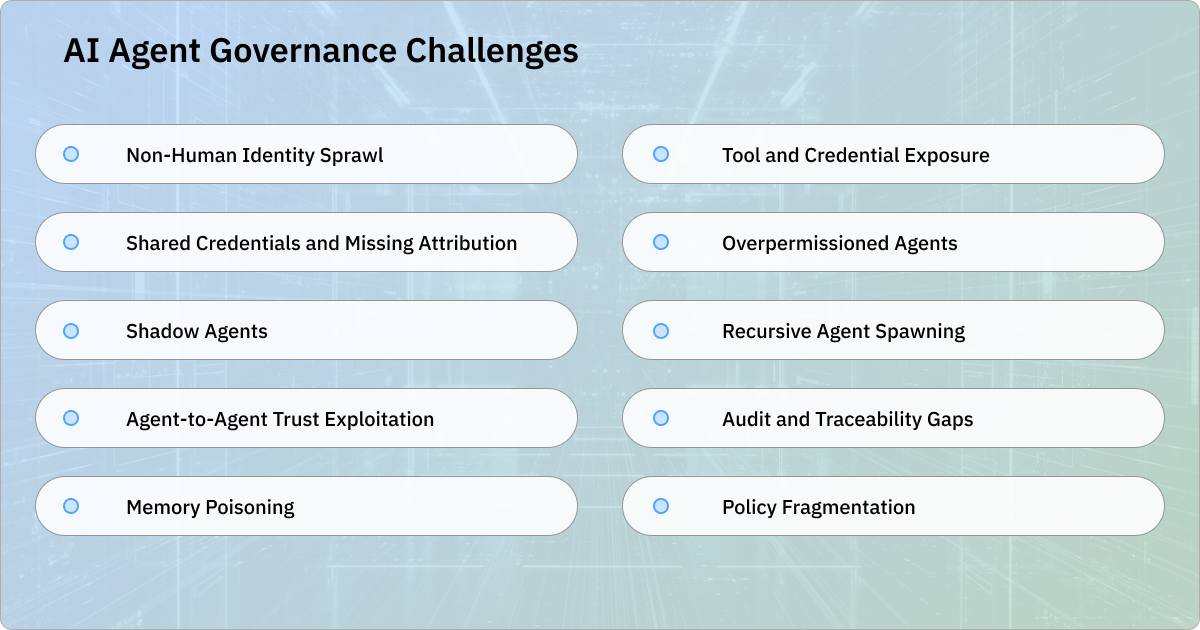
The risks from agentic AI are evolving at a pace that’s hard to match. In a 2025 survey of 353 enterprise security professionals, 80% said their organizations’ agents had taken unintended actions, including accessing unauthorized systems or sharing sensitive data. Governance challenges include nonhuman identity sprawl, shadow agents, credential exposure, and more.
AI governance challenges
Nonhuman identity sprawl
Nonhuman identities, a broader category than AI agents, sometimes outnumber human accounts. Many agents are created on demand by employees, without IT oversight. These agents may never receive a clear, accountable owner. They can create compliance exposure and runaway spend.
Shared credentials and missing attribution
With less than a quarter of organizations treating agents as independent identities, most still authenticate agents through shared API keys or generic service accounts. When an incident occurs, investigators can’t tell which agent took the action, which turns incident response into reconstruction work.
Shadow agents
Agents get built and deployed across departments using low-code platforms, embedded SaaS copilots, and personal coding assistants, often outside of any IT registry. A security team can’t govern an agent if it doesn’t know it exists.
Agent-to-agent trust exploitation
When one agent passes output to another to complete a multi-step workflow, that handoff is a trust boundary, and an unscanned handoff is an opening for prompt injection or data exfiltration disguised as a routine message between two systems that both believe the other is acting in good faith.
Memory poisoning
Agents that build institutional memory as they work are vulnerable to adversarial instructions designed to alter their future behavior. An attacker doesn’t need to compromise an agent directly; corrupting what it remembers is enough to steer what it does later.
Tool and credential exposure
Agents connect to internal systems and external services through API keys, OAuth tokens, and MCP servers. Poorly designed integrations may expose credentials or secret-bearing tool output to the agent’s model context, where prompt injection can exploit them. Well-designed systems keep secrets out of model-visible context and mediate access through scoped tools.
Overpermissioned agents
Agents are frequently provisioned with broad, persistent access because it takes more time to scope permissions precisely than grant a wide default. Access often persists long after the task is finished, which means a single compromised agent can have far more reach than it should.
Recursive agent spawning
Some production agents can create and assign tasks to other agents, and each spawned agent can inherit the same governance gaps as the one that spawned it. Sprawl compounds with every layer.
Audit and traceability gaps
A 2026 Cloud Security Alliance survey found that only 21% of organizations maintain a real-time registry or inventory of their agents. Without agent-level identity and ownership, organizations may also struggle to trace an agent’s actions to a responsible human sponsor.
Policy fragmentation
Agents now run across SaaS platforms, cloud AI services, internal tooling, and local developer endpoints, each with its own access model and its own security posture. A policy enforced in one environment frequently has no equivalent in another, which leaves the most permissive environment as the organization's actual security baseline.
Features to look for in an AI agent governance platform
Agents require a structural solution.
Security teams don’t just have to understand which AI models are in use. They need to know which agents are running, what they can do once they start a task, what they’re allowed to connect to, and whether there’s a record of their actions.
This requires a structural solution, not just a policy that governs the agent at the point of deployment. You need a control layer that evaluates every governed action the agent takes (as it takes it) and generates an audit-ready record of each decision.
As you assess AI agent governance infrastructure options, there are some key capabilities to look for:
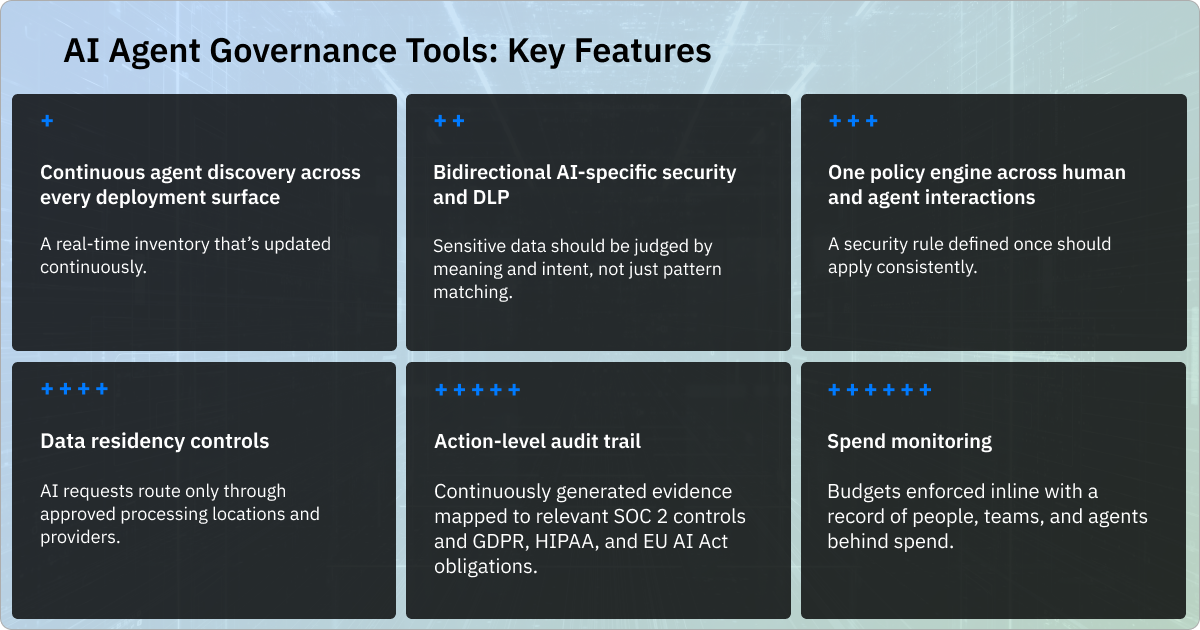
1. Continuous agent discovery across every deployment surface
You need to find agents across the deployment surfaces in scope: SaaS-embedded copilots, home-grown applications on cloud AI services, agents built by employees on low-code platforms, browser-based agents, coding assistants on developer endpoints, and agents spawned dynamically at runtime by other agents. You should have a real-time inventory that’s updated continuously.
2. Bidirectional AI-specific security and DLP
Scanning needs to happen at both ends of every model interaction. Your security should pair proven controls with AI-native capabilities. Your AI firewall should stop prompt injection, jailbreak attempts, and malicious payloads before they reach the model. Sensitive data should be judged by meaning and intent, not just pattern matching. Prompts, responses, tool calls, and agent actions should be secured before they proceed.
3. One policy engine across human and agent interactions
A security rule defined once should apply consistently, whether the interaction originates from an employee typing a prompt, an agent executing a task, or one agent passing context to another. Department-scoped policies, model access controls, and action allowlists should all be enforced the same way.
4. Data residency controls
Your platform should sit on the execution path for the agents and model calls it governs. Data residency controls should route AI requests only through approved processing locations and providers, blocking requests that violate residency policy before data leaves the environment.
5. Action-level audit trail with chain of custody
Every policy decision and governed action should be recorded in a continuous audit trail from an agent's initial request to its final outcome. The record should include the policy that triggered each decision, the specific detection that flagged it, and the outcome, without unnecessarily retaining raw prompt or response bodies. Evidence can be mapped to relevant SOC 2 controls and GDPR, HIPAA, and EU AI Act obligations and ingested by existing SIEM tooling. This mapping supports assessment; it does not establish compliance on its own.
6. Spend monitoring as it happens.
Your tool should monitor spend on the governed path as it happens, tracking the people, teams, and agents who created it. It should enforce budgets inline, before the model call and before the bill arrives.
The 5 Best AI Agent Governance Platforms in 2026
The right starting point for governance depends on where your most urgent gap is. If you don’t know which agents are currently running, you need to focus on discovery first. If you can inventory agents but can’t trace their actions, you need audit infrastructure. If you’re doing both of those things, but you can’t demonstrate compliance, policy mapping should be a priority. Teams that face shrinking timelines and pressure to facilitate AI adoption will get the most out of a product that covers discovery, policy, compliance, and productivity in a single governed workspace.
Credo AI
Credo AI describes itself as a platform for discovering, assessing, and governing every AI agent, model, and application in an enterprise from a single system, with auto-discovery that extends to shadow AI. Its governance engine is built around AI-native risks, including hallucination, drift, and emergent agent behavior. Its GAIA agent automates intake, risk identification, and control recommendations to reduce manual review load.
Policy packs for the EU AI Act, NIST AI RMF, ISO 42001, SOC 2, and HITRUST automate evidence collection and map evidence to relevant controls and obligations. They can support compliance work but do not establish compliance on their own. For agent governance specifically, Credo AI offers structured intake and risk assessment before deployment, treating each new agent as a use case that needs to be reviewed rather than assuming it can be governed after the fact.
Best for: Compliance teams that need a structured, policy-mapped governance process for reviewing and approving agent deployments, particularly in regulated industries.
First Recon AI
First Recon AI brings a structural solution to agent governance. It offers a single platform for governance, security, and productivity. Instead of adding a layer of oversight to the environment, First Recon is the environment: a single managed workspace where employees can engage safely with AI agents.
Teams create, share, and run agents in Agent Hub, doing real work with company data, at machine speed. Within Agent Hub, AI Security Runtime governs every action an agent takes: each tool call, data read, and handoff is evaluated with identity, data, and destination attached, then allowed, redacted, held for human review, or blocked before execution.
Agent-related spend is measured as it happens, and budgets are enforced inline, before the bill arrives. The platform provides optimization signals, recommending model substitutions and caching. Governance evidence is generated automatically: Every enforcement decision leaves behind an audit record, and compliance evidence is mapped to relevant controls and obligations in frameworks like SOC 2, GDPR, HIPAA, and the EU AI Act, and SIEM integration makes evidence readily available. The mapping supports compliance assessment rather than replacing it. Agent behavior is judged by meaning and intent, drawing on the Semantic Security Engine and Security Context Graph, so threat and sensitive-data detection grows more accurate as your organization uses AI.
Organizations can test out First Recon’s agent governance features through a free 30-day trial.
Best for: Enterprises in all sectors with multiple AI agents and models already in use and where compliance, spend, and productivity are top concerns.
Zenity
Zenity governs agents across their full execution path, examining tool calls, memory access, data usage, and control flow to identify intent-driven risk rather than matching isolated alerts to predefined signatures.
Its platform organizes around three capabilities: “Observe” offers continuous discovery and inventory across SaaS-embedded, cloud-hosted, and endpoint agents. “Govern” enforces secure-by-design policy before risky configurations reach runtime. “Defend” detects and responds to threats within the context of what the agent was trying to accomplish. Coverage extends to agents embedded in Microsoft 365 Copilot, Salesforce Agentforce, and Copilot Studio as well as home-grown agents built on Microsoft Foundry, AWS Bedrock, and Google Vertex AI.
Best for: Security teams that need detection across agent configuration and runtime behavior in both SaaS-managed and custom-built environments.
Noma Security
Noma Security maps what it calls the agent blast radius through its Agentic Risk Map: for every agent in the environment, it visualizes the full set of systems, data sources, and other agents that a compromise would affect, then uses that map to identify dangerous capability combinations before an agent is ever enabled for production.
Agents start in a disabled state and must be explicitly approved after Noma completes a risk assessment of their intended capabilities, planned connections, and configured permissions. Once in production, runtime monitoring watches for prompt injection, unauthorized tool invocations, and anomalous agent-to-agent communication against the baseline established during assessment.
Best for: Organizations that need to understand cascading risk across interconnected agent ecosystems before deployment, with continuous monitoring once agents are live.
Holistic AI
Holistic AI built its governance platform around automated discovery of ungoverned AI across cloud platforms, code repositories, and SaaS applications. After discovery of ungoverned uses, it assesses and continually tests what it finds.
It deploys what it calls Sentinel Agents to observe AI behavior continuously, and Operative Agents that can intervene in real time when a system crosses a defined risk threshold, including deployment gates and kill switches.
Bias and fairness testing runs alongside security assessment, which distinguishes Holistic AI from platforms focused primarily on access control and runtime threat detection. Built-in framework coverage includes the EU AI Act, NIST AI RMF, ISO 42001, and NYC Local Law 144.
Best for: Organizations whose governance requirements include continuous bias and fairness monitoring.
The stakes are climbing for agent governance
The pressure to govern AI agents is only getting stronger. Adoption is not slowing down: In January 2026, McKinsey CEO Bob Sternfels said the firm counted 20,000 AI agents alongside 40,000 human employees and expected one or more agents per employee within 18 months. Meanwhile, the EU AI Act is raising the stakes for organizations within its scope, while NIST’s AI Agent Standards Initiative is developing voluntary standards and guidance rather than regulation. To keep up, security and compliance teams need structural governance solutions that will help them safely scale agent use and weather the onslaught of changes to come.