Agents are proliferating at a lightning pace. According to research by Gartner, 40% of enterprise applications will be integrated with task-specific AI agents by the end of 2026, up from less than 5% in 2025. And they’ve already reshaped the workplace. Agents are writing emails, pulling from databases, and running code, often without a single human in the loop.
The potential gains in productivity are staggering. But so is the risk. Agents operate at a speed and scale that traditional management and security systems weren’t designed for, and IT teams are running into an unnerving gap between what they can see and what agents are actually doing.
AI agent security platforms close that gap. Below, we’ll cover the problems these platforms solve, the features that really matter, and our review of leading products on the market today.
Why do organizations need AI agent security platforms?
Purpose-built technology mitigates the biggest risks from agentic AI.
The threats from agentic AI are pervasive. Eighty percent of organizations in one study had already encountered risky behaviors from agents, and the damage they inflict is sometimes irreversible. This isn’t just a problem for enterprises. It’s a problem for the AI sector as a whole: Researchers at Princeton have raised concerns that without intervention, the security challenges associated with AI agent systems could dampen their utility and reliability, ultimately leading to a slowdown in adoption.
Let’s take a look at the biggest risks AI agents pose to enterprises, and how security platforms can mitigate them.
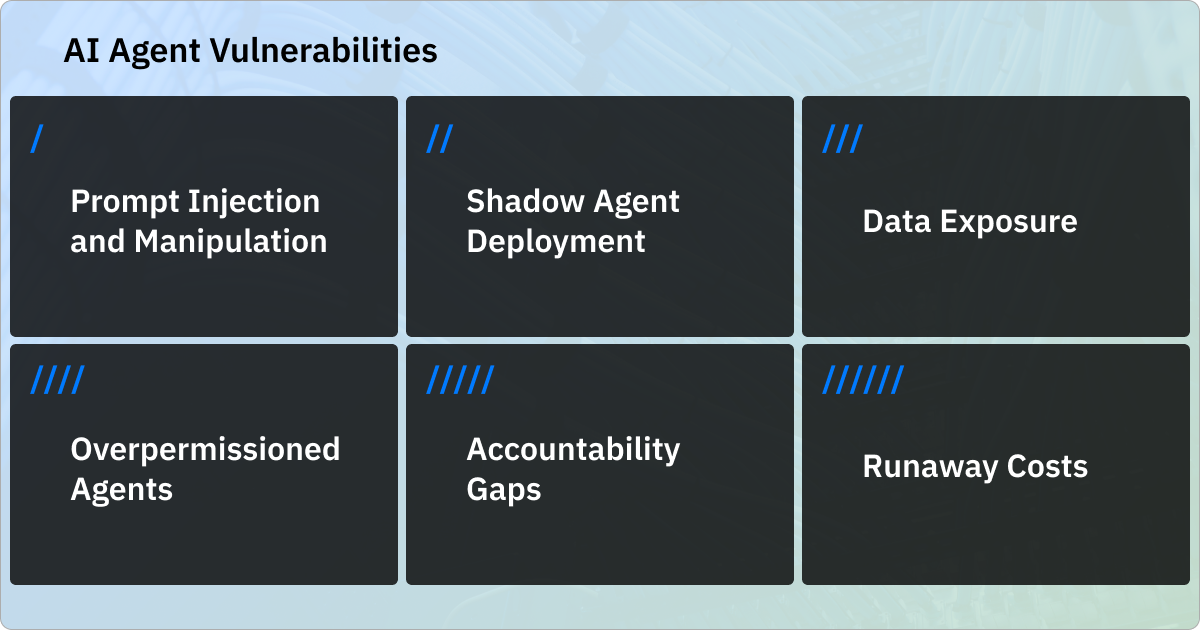
AI Agent Risks and Mitigation
1. Risk: Prompt Injection
Prompt injection is a serious threat, and it’s growing: Google observed a 32% relative increase in content classified as containing malicious indirect prompt injections between November 2025 and February 2026. Attackers hijack agents by embedding malicious instructions in content like websites, documents, and email threads. Once manipulated, an agent can leak credentials, execute unauthorized commands, or pivot across connected systems, potentially without triggering conventional security alerts.
Solve: Real-Time Threat Detection and Analysis of Behavior
Effective defense requires enforcement at two chokepoints: The point where assembled context flows into the model, and the point where agent actions flow out through tool calls. Before a prompt reaches the model, the runtime should inspect the full assembled interaction and judge it by behavior and intent rather than pattern matching alone.
2. Risk: Shadow Agent Deployment
Your marketing, engineering, and HR teams could all be spinning up their own agents without any centralized awareness or control. Every agent that the security team doesn’t see and can’t manage opens the door to serious risk.
Solve: A Visible Inventory of Every Agent
One of the core functions of an AI security platform is the ability to shine a light on shadow AI. Through continuous discovery, platforms can surface agents through their covered discovery sources. Your app should allow you to observe AI destinations from live traffic on your macOS and Windows fleet, not just from surveys. You should have a real inventory of which teams are using which tools with which data.
3. Risk: Data Exposure
Agents operating in email, document storage, CRM, and code repositories create new leakage vectors at every step of a workflow. DLP tools designed for static files generally do not inspect agent execution context or intercept tool invocations in real time.
Solve: AI-Fluent DLP
Traditional DLP often relies on classifiers and pattern matching, but it generally does not evaluate an agent's task intent. Now we need DLP that understands AI agent interactions and scans prompts and outputs for sensitive content in real time (vs. static controls that agents can bypass).
4. Risk: Overpermissioned Agents
It’s all too common for agents to inherit permissions that exceed what’s needed for the task at hand. For example, a customer service agent with access to billing data, user records, and internal APIs creates a broad attack surface if those permissions are not scoped to the task.
Solve: Managed Access
The answer to overpermissioned agents is scoped, revocable tool connections that enforce least-privilege access at the integration level, so that a compromised agent can’t reach systems beyond its defined mandate.
5. Risk: Accountability Gaps
When an agent takes an action that causes harm, like data exfiltration, unauthorized API calls, or bad decision-making, it’s difficult to reconstruct what happened. As a Cloud Security Alliance report notes, “An agent might call a dozen tools, spawn multiple sub-agents, read from a vector database, and write to a production API, all within a single task execution, with the intermediate reasoning states that determined those actions remaining inside the model and inaccessible to conventional logging.”
Solve: Automated Audit Trails
Comprehensive audit trails that automatically log every action, tool invocation, and available execution trace with enough detail to meet the needs of auditors, incident responders, and regulators.
6. Risk: Runaway Costs
Ungoverned agents = ungoverned costs. Your employees could be using agents across dozens of different tools, models, and departments, quietly racking up spend the whole time. Without attribution, your finance team can't identify which function or project is driving these expenses.
Solve: Visibility and Policy Enforcement
If you want to control spend, the first thing you need is visibility. Security platforms can expose agent use within the environments they cover, laying the groundwork for your FinOps team to manage costs.
What features matter most when choosing an AI agent security platform?
Agents fundamentally change security needs.
The emergence of agents has flipped core security assumptions. We now have to think differently about identity, data flow, decision authority, evidence, speed, and supply chain.
To some extent, your industry and the way you use agents will influence which security tools are right for you. But there are a handful of capabilities that are essential, no matter what your company does. Here’s our list of the features that matter most.
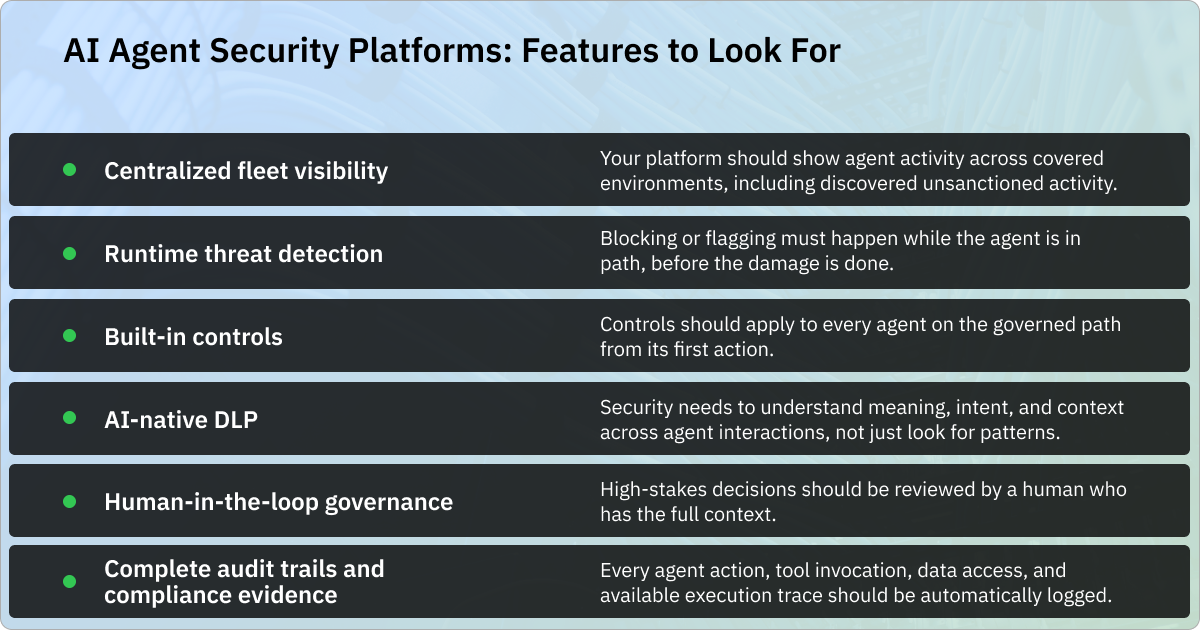
1. Centralized fleet visibility
We can’t say this enough: If you don’t see it, you can’t govern it. Your platform should provide visibility on agent activity across covered environments, including discovered unsanctioned activity. You should have access to agents’ live status, current task or execution state, token consumption, and security posture. Ideally, you’ll have a central, secure AI productivity workspace where you can watch agents execute tasks, inspect their available execution traces, and, if needed, intervene.
2. Runtime threat detection
Behavioral monitoring must detect prompt injection, jailbreaks, memory poisoning, tool misuse, and anomalous data access in real time, not in post-incident review. Blocking or flagging must happen while the agent is in path, before the damage is done.
3. Built-in controls
Security shouldn't be bolted onto agents after deployment. Look for a platform with built-in DLP scanning, AI firewall protections, response protection, and gateway controls. These controls should apply to every agent on the governed path from its first observed action, regardless of who built the agent or which supported tool it connects to.
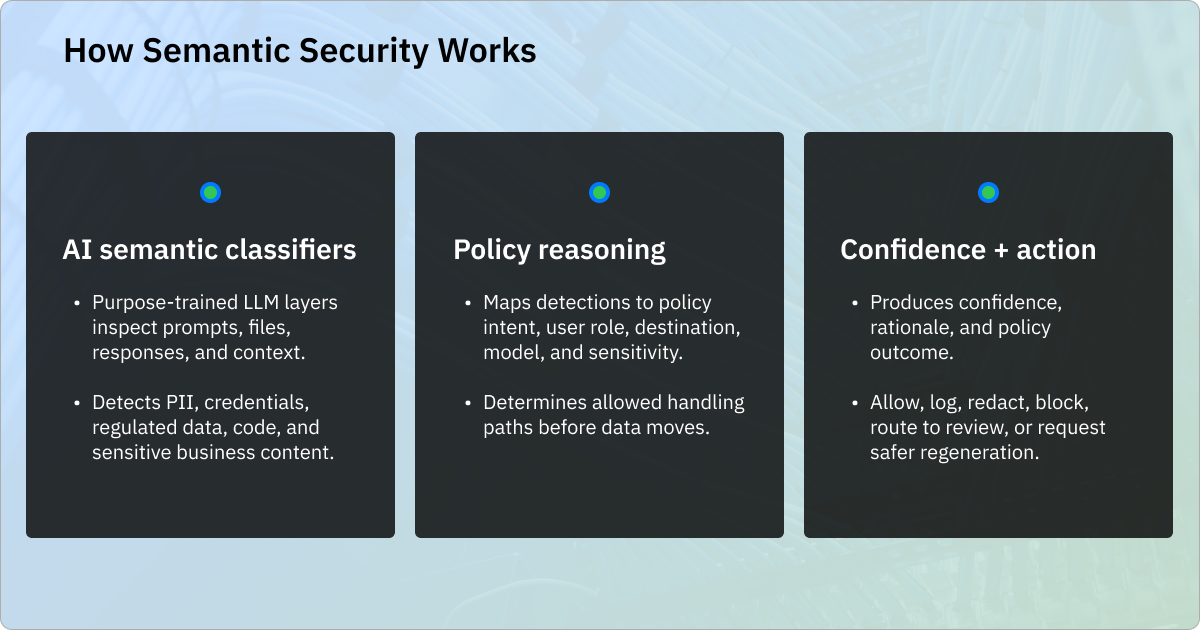
4. AI-native DLP (semantic security)
To protect sensitive data in an AI environment, your security needs to do more than recognize a specific string of text. It needs to understand meaning, intent, and context across AI interactions. Look for a platform with AI-fluent semantic security that inspects prompts, files, responses, and context to detect sensitive content.
5. Human-in-the-loop governance
Your platform should allow you to custom-configure autonomy levels. High-stakes decisions should be reviewed by a human who has the available decision context (the agent's task, data sources accessed, proposed action, and applicable policy) before anything happens.
6. Complete audit trails and compliance evidence
Every agent action, tool invocation, data access, and available execution trace should be automatically logged, ideally with compliance-grade detail. The full chain, from trigger to outcome, should be inspectable. You should easily be able to access evidence supporting SOC 2 controls, SIEM integration, and on-demand compliance exports without manual reconstruction.
The 6 best AI agent security platforms in 2026
Not all AI agent security platforms are designed to solve the same problem. Some detect what’s already running in your environment, while others govern how agents are used from the beginning. When you’re choosing a tool, it can be helpful to start by thinking about which layer of your AI stack is most exposed. Given how fast the AI threat landscape is moving, it's also worth asking not just what a platform does today but how actively it's developing capabilities for the future.
To help you navigate the market, we’ve reviewed six leading platforms (in no particular order).
Zenity
Zenity is a security and governance platform built specifically for AI agents. It covers the full agent lifecycle, from build time to runtime, across three environments: SaaS-managed agents like Microsoft 365 Copilot and Salesforce Agentforce, cloud-hosted agents built on AWS Bedrock, Microsoft Foundry, and Google Vertex AI, and device-based agents running on endpoints including GitHub Copilot, Cursor, and Claude Desktop.
The platform is organized around three layers. Surface handles discovery, posture, and exposure management. It shows which agents exist, who owns them, what tools and data they access, and how they behave in production. This includes shadow agents and MCP servers running on user devices. Enforce applies policy at decision time through controls such as Runtime Boundaries. Protect handles detection and response, identifying unsafe behaviors (e.g., prompt injection, memory poisoning, misuse of privileged tools) and enabling inline prevention.
Zenity connects build-time configuration with live runtime telemetry, so posture gaps and runtime anomalies are correlated rather than treated as separate signals. Recent integrations include runtime security for Microsoft Foundry, a ServiceNow SecOps partnership, and availability on AWS Marketplace.
Best for: Organizations with significant existing agent deployments, where the primary need is visibility into what agents are doing and governance over how they're configured and operating.
First Recon AI
First Recon AI takes a different approach than most other platforms. Instead of tackling one part of the problem, it centralizes security, control, and productivity in a single app. It’s the environment agents run in, not a separate control layer applied on top.
With First Recon’s Enterprise AI Workspace, teams use Agent Hub to create, share, and run agents that do real work with company data at machine speed. AI Security Runtime governs every action they take: each tool call, data read, and handoff is evaluated with identity, data, and destination attached, then allowed, redacted, held for human review, or blocked before execution.
The same controls are applied consistently across ChatGPT, Claude, Gemini, Copilot, and other supported providers, regardless of which department is using the agent or which model it's running on. Every agent built or deployed through First Recon AI inherits DLP scanning, AI firewall protections, response protection, and gateway controls from its first action. There's no configuration window between deployment and protection.
A key innovation is First Recon’s Semantic Security Engine. Unlike traditional cloud and network DLP tools, which often rely on classifiers and pattern matching, semantic security evaluates meaning and context, so it can identify sensitive information even when it doesn’t match a predefined pattern. This is a practical adaptation to the contextual nature of AI: Employees ask questions and describe scenarios in natural language. Existing gateway and firewall controls can complement First Recon AI’s semantic security by covering network, provider, and perimeter inspection paths. First Recon AI offers a free 30-day trial, which gives teams a chance to see how it works in practice.
Best for: Enterprises of all sizes and sectors that need a single platform for AI security, control, and productivity. Well-suited for entities with multiple departments that are already running or planning agents across different providers.
Cisco AI Defense
Cisco AI Defense is the AI layer embedded within Cisco's broader security and networking infrastructure. In early 2026, Cisco added specific capabilities focused on the agentic attack surface. An AI Bill of Materials provides centralized governance for AI software assets, including MCP servers and third-party dependencies. The MCP Catalog discovers and inventories MCP servers across public and private platforms, managing risk at the tool connection layer. Real-time AI guardrails continuously monitor and inspect agent interactions to detect manipulation or unsafe behavior, including poisoned tools or prompts designed to trigger unauthorized tool use.
Cisco’s Duo agentic identity capabilities support registration of active AI agents and mapping them to accountable human owners, while Cisco Identity Intelligence discovers agentic and non-human identities across an organization's environment. Because the platform spans both identity and network infrastructure, it can surface agentic identities that have not been formally registered with an identity provider. These capabilities provide agent inventory, authentication, and access control as part of Cisco's broader security portfolio, which also includes an Agent Runtime SDK that embeds policy enforcement directly into agent workflows at build time across AWS Bedrock AgentCore, Google Vertex Agent Builder, Microsoft Foundry, LangChain, and other platforms.
Best for: Enterprises already operating within the Cisco security ecosystem who want AI agent protection to integrate with existing SASE, network, and identity infrastructure.
Palo Alto Networks Prisma AIRS
Palo Alto Networks launched Prisma AIRS 3.0 in March 2026. It positions Prisma AIRS as a platform to secure the entire agentic AI lifecycle, from development through runtime execution. Prisma AIRS 3.0 addresses risk across three layers: the AI supply chain, where compromised models, agent code, and external context shape behavior before execution; posture risks, where overpermissioned agents operate across environments; and runtime, where agent behavior can be redirected mid-task.
Development-time security scans agent code, configurations, and tool integrations before deployment, surfacing overprivileged access and insecure MCP server configurations. An AI Runtime Firewall inspects traffic for prompt injection, sensitive data leakage, insecure outputs, and model denial-of-service attacks. In May 2026, Palo Alto Networks acquired Portkey, an AI Gateway company, integrating it into Prisma AIRS as a centralized control plane to monitor, orchestrate, and govern autonomous agents at scale. It routes requests to appropriate models, monitors token usage, and enforces consistent policies across all agent interactions.
Best for: Large enterprises with existing Palo Alto Networks infrastructure that need end-to-end agentic AI security integrated into their existing network and cloud security stack.
Holistic AI
Holistic AI built its platform around automated discovery of ungoverned AI across cloud platforms, code repositories, and SaaS applications. Every agent and AI artifact, including models, datasets, endpoints, and pipelines, is managed in a single, structured registry. After discovering agents and other uses, the platform assesses and continually tests what it finds. It deploys what it calls Guardian Agents to observe AI behavior continuously, and Operative Agents that can intervene in real time when a system crosses a defined risk threshold, including deployment gates and kill switches.
Bias and fairness testing runs alongside security assessment, which distinguishes Holistic AI from platforms focused primarily on access control and runtime threat detection. Built-in framework coverage includes the EU AI Act, NIST AI RMF, ISO 42001, and NYC Local Law 144.
Best for: Organizations where AI agent discovery and inventory are the most pressing need.
Microsoft Agent 365
Microsoft's approach to AI agent security runs through its familiar infrastructure. At RSAC 2026, Microsoft announced Agent 365, which is designed to act as a control plane for observing, governing, and securing AI agents and their interactions (including Microsoft AI agents and others) through existing admin and security workflows.
Copilot Studio customers can manage agents with shared policies, security controls, and lifecycle oversight. Security Copilot agents operate across Microsoft Defender, Entra, Intune, and Purview, handling phishing triage, identity threat detection, and data security. Microsoft is also expanding Sentinel as an agentic defense platform, unifying context, automating end-to-end workflows, and standardizing access, governance, and deployment across security solutions. Microsoft released an open-source Agent Governance Toolkit in April 2026. The toolkit is designed to address all 10 OWASP agentic AI risks with deterministic, rapid policy enforcement.
Best for: Enterprises already operating within the Microsoft ecosystem (Microsoft 365, Azure AI, Copilot Studio), where agent governance needs to integrate directly with existing workflows, identity infrastructure, and security operations.
Embedding agent governance from the start
Treating security as a barrier to AI adoption is a mistake. The companies that see the most gains from agentic AI won’t be the ones that shortcut security; they’ll be the ones that build governance in early enough that it never becomes a bottleneck. As McKinsey Partner Rich Isenberg has noted in the 2026 report Trust in the Age of Agents, “The goal for leaders isn’t to slow innovation. It’s to make safe scaling repeatable.”