Every new AI model in your company further broadens your exposure to data leakage, regulatory scrutiny, and runaway costs. In many cases, these models haven’t been formally approved, aren’t monitored, and don’t have a documented owner or audit trail.
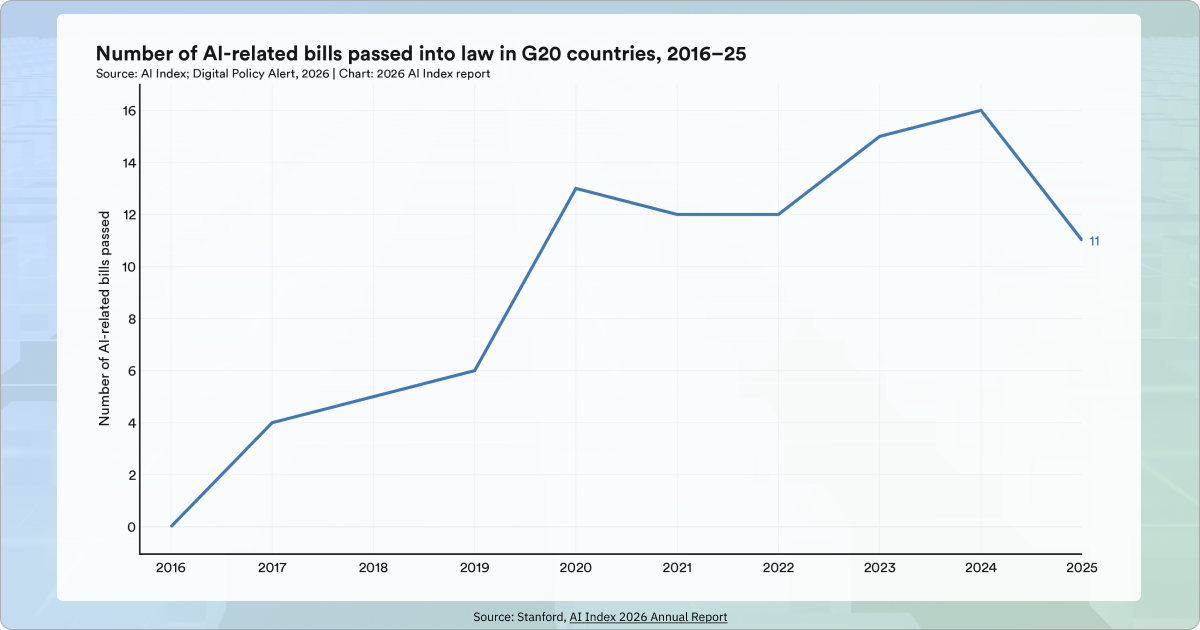
This ungoverned AI use is a compliance threat, and it’s growing. Ten years ago, there were no AI-related laws among G20 countries. Now the US alone has passed 25 different bills, and in Europe, the EU Artificial Intelligence Act is introducing phased obligations for covered providers, deployers, importers, and distributors. Deloitte’s 2026 State of AI in the Enterprise report found that only one in five companies had a mature governance model for autonomous AI agents.
In response, a growing number of organizations are investing in resources, from staff to technology. AI-specific governance job postings increased 17% year over year, and many companies are now relying on specialized platforms designed to support AI governance.
In this guide, we discuss the governance challenges introduced by the advancement of AI models, the features to look for in an AI governance tool, and the leading products on the market today. We use AI model governance broadly: some products below focus on lifecycle governance, while others emphasize runtime security, agent governance, or policy enforcement.
The risks AI model governance tools address
Every new model in use creates exposure.
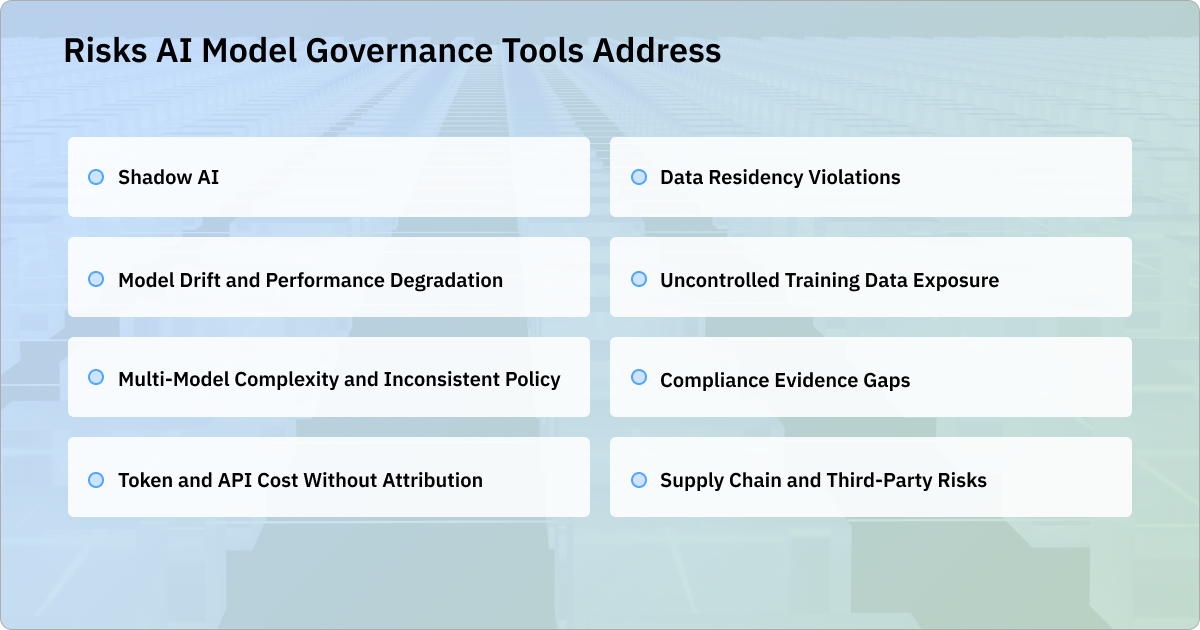
AI has introduced risks that may not be fully addressed through general security hygiene or traditional compliance frameworks alone. They’re specific to how models are adopted, operated, and monitored. AI model governance tools are designed to address these new concerns, which include shadow AI, data residency violations, model drift, data exposure, multi-model complexity, compliance issues, and supply chain risk.
AI governance concerns
Shadow AI
Employees adopt AI models the same way they once adopted SaaS tools: by signing up with a personal or work email, using them for real work, and assuming someone else is thinking about the implications. A team that spends six months building workflows on a consumer model may discover only at contract renewal, or after a breach, that IT never knew it existed.
Data residency violations
Enterprise AI services vary in where they process and store data, and residency options often depend on the provider, product, region, and contract. Without appropriate configuration and contractual controls, regulated data or customer PII may be processed in an unintended jurisdiction. This can create cross-border transfer, contractual, or sector-specific compliance issues that surface later during audits or after incidents.
Model drift and performance degradation
A model that was thoroughly tested and approved at deployment may not maintain the same performance as data and operating conditions change. Without ongoing monitoring, an organization may miss model drift, performance degradation, or an unapproved model or version change.
Uncontrolled training data exposure
Consumer and freemium AI tools commonly use submitted content to improve their models. An employee who pastes a contract summary, financial model, or patient record into a public tool may be contributing proprietary or regulated data to a training dataset the organization has no visibility into and no ability to recall.
Multi-model complexity and inconsistent policy
Different teams use different models and have different assumptions about what's acceptable. Without a central policy layer, the organization may struggle to enforce consistent controls across all of them or determine which models processed regulated data in a given time window.
Compliance evidence gaps
Depending on the applicable requirements, regulators and auditors may ask for evidence that governance policies were followed. Organizations may need to show which AI systems were approved, when access was granted, who approved it, and what controls were in place. Assembling that evidence manually from disconnected logs can take weeks.
Token and API cost without attribution
Model usage incurs real costs that compound across teams. Without attribution at the team or department level, finance can't tell which business unit is driving spend, and security can't assess whether usage patterns suggest unauthorized activity. Token costs that grow without visibility are not just a budget problem. They’re a sign that model access isn't being governed.
Supply chain and third-party risks
Open-weight model packages downloaded from repositories can contain malicious code, unsafe serialization, compromised dependencies, or backdoors; poisoned training data can also affect model behavior. A model that passes initial evaluation may behave differently under specific input conditions, and artifact risks can go undetected after deployment unless the organization continues scanning and monitoring. Connecting to an external model provider means trusting that provider's security posture and data handling practices. Organizations that adopt open-weight models without a scanning and provenance workflow are accepting supply chain risk they probably haven't formally evaluated.
Features to look for in an AI model governance platform
A set of core capabilities will help you adapt as models scale.
When you have four or five models in production, model governance might seem manageable. But when that number sprawls to fifty, things change. The key is to establish the right infrastructure early on. The right AI model governance tool will ease the burden, addressing security, compliance, and cost concerns, so your teams can make the most of emerging AI capabilities. When you’re evaluating AI model governance platforms, there are some core features to prioritize:
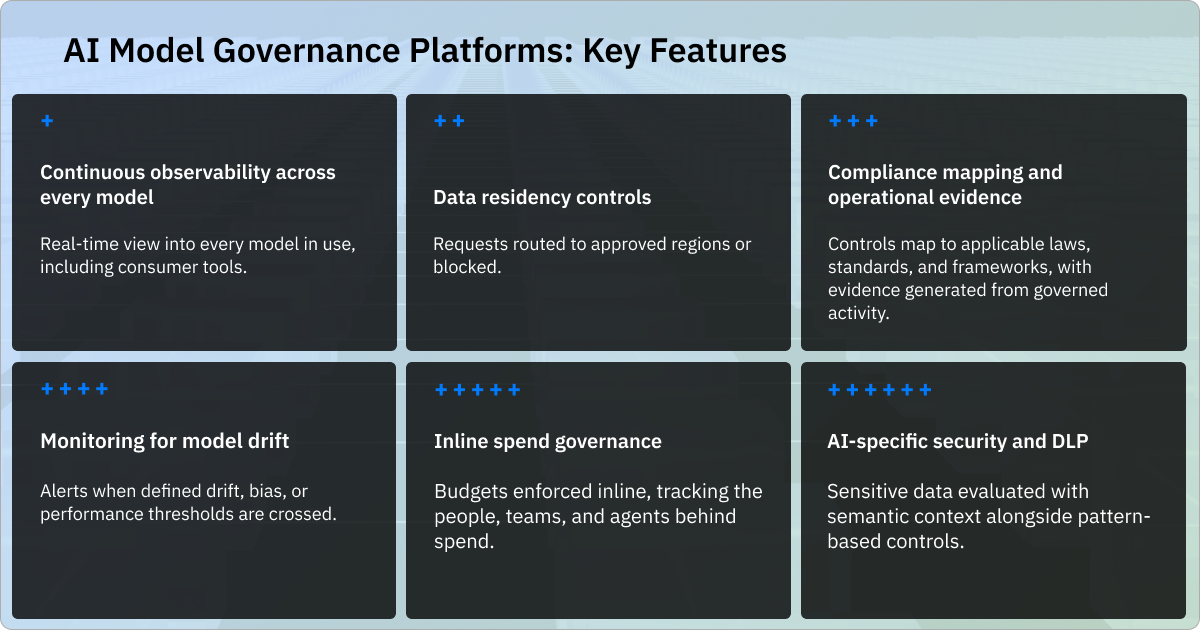
1. Continuous observability across every model and provider in use.
Your platform needs visibility across relevant supported models and consumer tools accessed through browsers, so governance gaps can be identified. That observability should be near real time where the risk requires it, rather than depending only on later log reviews. Where feasible, approved models should sit behind governed routes with policy, rate limits, and live visibility.
2. Data residency controls that block violations before data leaves the environment.
Residency policy can't be enforced retroactively. An inline control point can sit between users and model endpoints, route requests to approved geographic regions, and block requests that would violate configured residency rules before they are sent. Provider settings, system architecture, and contractual controls also matter.
3. Compliance framework mapping with automatic evidence generation.
The platform should map model governance controls to the applicable laws, standards, and assurance frameworks, such as GDPR, HIPAA, the EU AI Act, and SOC 2. It should generate records from governed operations that can support audits and assessments. Control mappings and records do not establish compliance by themselves.
4. Model monitoring for drift, bias, and performance degradation.
Governance doesn't end at deployment. The platform should continuously track whether approved models are still behaving as they were approved to behave, alerting when drift, bias, or performance degradation crosses a defined threshold. This is the operational layer that keeps a point-in-time approval current over the model's production lifecycle.
5. Spend governance with token-level attribution.
Your tool should monitor spend on the governed path as it happens, tracking the people, teams, and agents who created it. It should enforce budgets inline, before the model call and before the bill arrives.
6. AI-specific security and DLP
Your security should pair proven controls with AI-native capabilities. An AI firewall should help detect and block prompt injection, jailbreak attempts, and malicious payloads before they reach the model. Sensitive data should be evaluated with semantic context alongside pattern-based controls. Supported prompts, responses, tool calls, and agent actions should be secured before they proceed.
The 5 Best AI Model Governance Platforms in 2026
CISOs and security teams everywhere are under pressure. As AI adoption escalates, stakeholders want to understand an organization’s risk exposure. Teams need a reliable way to predict spend and manage compliance obligations. At the same time, they’re working with business units that are pushing to deploy AI as quickly as possible, and employees are already using unsanctioned applications. AI model governance platforms are designed to ease this pressure.
Below is our review of the leading AI model governance tools on the market (in no particular order).
Noma
Noma's model governance capabilities are embedded in a broader AI security platform, with a dedicated Governance and Compliance module that connects discovery, policy enforcement, and audit trail generation into a single workflow. The platform is built to keep organizations audit-ready through real-time visibility, automated controls, and policy enforcement across the entire AI environment, with findings mapped to the EU AI Act, ISO 42001, and NIST AI RMF, alongside security references including the OWASP LLM Top 10 and MITRE ATLAS.
An AI inventory built from continuous discovery across integrations, including cloud AI services, no-code and low-code agent platforms, MLOps tools, and source code management, provides records that can support regulatory documentation and inventory requirements where applicable.
The recent launch of Agent Access Control added a dynamic Enterprise Agentic Registry that surfaces every agent, connected MCP server, and tool with context already attached, showing what each server exposes, which agents connect to it, and where each stands against current security policies. Each agent is assigned a distinct identity rather than operating under shared credentials, with governance states of Approved, Requires Review, or Blocked configurable per agent and MCP connection. The platform records prompts, responses, tool calls, and enforcement actions for compliance and forensic analysis.
Best for: Enterprise security teams managing complex AI environments across multiple agent frameworks, MCP servers, and cloud platforms.
First Recon AI
The First Recon AI approach is distinct: It offers a single platform for governance, security, and productivity. Instead of adding a layer of oversight to the AI environment, First Recon is the AI environment; it’s a governed workspace where employees can engage safely with AI models. They can chat, create agents, and access a whole suite of productivity capabilities in one place.
Governance evidence is generated automatically through normal workflows, so you don’t have to pull it together retroactively. Every governed interaction leaves behind an audit record, and compliance evidence is mapped to SOC 2, GDPR, HIPAA, and the EU AI Act. There’s a sealed, metadata-only decision receipt for every enforcement decision. Compliance exports and SIEM integration make that evidence readily available.
AI Security Runtime, the enforcement layer that secures every AI interaction, also meters what each one costs. Spend is measured on the governed path as it happens and attributed to the people, teams, and agents who created it. Budgets are enforced inline, before the model call and before the bill arrives. To further manage spend, First Recon AI provides optimization signals, recommending model substitutions and caching.
First Recon’s Semantic Security Engine understands meaning and context, so it can identify sensitive information even when it doesn’t match a predefined pattern. Existing gateway and firewall controls can complement this by covering network, provider, and perimeter inspection paths.
Organizations can test out model governance features through First Recon AI’s free 30-day trial.
Best for: Security teams in all sectors where compliance and spend management are pressing concerns and productivity is a high priority. A good fit for enterprises where multiple AI models are already in use across different providers.
Palo Alto Networks: Prisma AIRS
Palo Alto Networks’ Prisma AIRS AI governance approach focuses on comprehensive AI model inventories, policies for sanctioned and unsanctioned models, prevention of data poisoning, model vetting and approval before deployment, continuous monitoring for anomalous behavior, and regular audits to ensure compliance.
The platform operationalizes this through AI posture and supply chain capabilities that identify AI applications, models, associated resources, component lineage, and data sources, while scanning model files for malicious code, backdoors, unsafe serialization formats, and insecure dependencies. These records can support documentation and risk-management obligations where applicable; they do not by themselves establish EU AI Act compliance.
Palo Alto Networks announced an integration between Cortex Cloud DSPM and Anthropic’s Compliance API intended to inspect Claude Enterprise conversation content, uploaded files, and generated outputs. Organizations should confirm current availability and supported scope. Following the completed Portkey acquisition, Prisma AIRS AI Gateway became generally available in July 2026. It provides a centralized control plane that enforces policies across supported models, logs token usage for cost attribution, and routes requests based on governance rules. Palo Alto's governance capabilities are strong on the security and inventory side: model discovery, policy enforcement, and audit logging of AI traffic.
Best for: Organizations running Palo Alto Networks infrastructure that want AI governance integrated with their existing security stack.
Microsoft Purview
Microsoft's AI model governance capabilities are embedded within its existing infrastructure, with Microsoft Purview as the primary governance layer. It classifies sensitive data, monitors how it moves across AI models, and enforces data handling policies, with assessments and reporting that can support obligations relevant to GDPR, HIPAA, and the EU AI Act.
The platform captures prompts and responses from Microsoft 365 Copilot and supported AI apps in the unified audit log, which can show how and when users interact with AI tools and references to Microsoft 365 files accessed. For Agent 365, supported audit events include agent-to-human, human-to-agent, agent-to-tool, and agent-to-agent interactions; Microsoft does not describe these records as exposing a model's hidden reasoning chain.
Agent identities and role-based access controls are managed through Microsoft Entra Agent ID and Agent 365 rather than Purview alone. Agent 365 acts as the control plane for observing, governing, and securing agents across Microsoft and other tools, with shared policies, security controls, and lifecycle oversight.
Best for: Enterprises already operating Microsoft 365, Azure, and the broader Microsoft security stack who want AI governance to extend naturally from existing compliance infrastructure.
Credo AI
Credo AI has been focused on AI governance since 2020. Its architecture is organized around the AI lifecycle: It aims to discover every AI system in the enterprise, assess it continuously against internal policies and external regulations, enforce governance workflows, and generate documentation for auditors and regulators.
It uses a centralized inventory system to cover models, agents, and applications. Its risk library includes AI-specific scenarios such as hallucination, drift, bias, and agent behavior rather than relying only on generic risk categories. Credo AI users have access to pre-built policy packs covering the EU AI Act, NIST AI RMF, ISO 42001, SOC 2, and HITRUST. It comes with automated evidence generation and cross-functional collaboration tools that are designed to bring legal, compliance, security, and engineering teams into a shared workflow. Its Govern AI Assistant adds agentic compliance workflows to the platform.
Best for: Enterprises in regulated industries that need dedicated, purpose-built AI governance infrastructure.
Governance infrastructure made to scale
The imperative to establish strong AI model governance is only getting more urgent. New regulations are kicking in, models are changing, and teams are adopting AI at a staggering rate. Governance infrastructure that’s ready to scale will help security teams keep pace, so they can say “yes” and help employees use AI not just to work more efficiently, but to do work that was previously impossible.