For most of the past three years, security teams have been playing catch-up with an LLM deployment pace that outstripped their ability to assess, govern, or protect AI systems. No matter which industry you’re in or the size of your company, your employees are almost certainly using LLMs, maybe daily. The question now isn’t whether to allow use, but how to secure the models that are already running.
This guide covers the risks that LLMs introduce, what to look for when evaluating LLM security platforms, and the top tools on the market in 2026.
What are key risks introduced by LLMs?
Models introduce structurally different risks that demand different solutions.
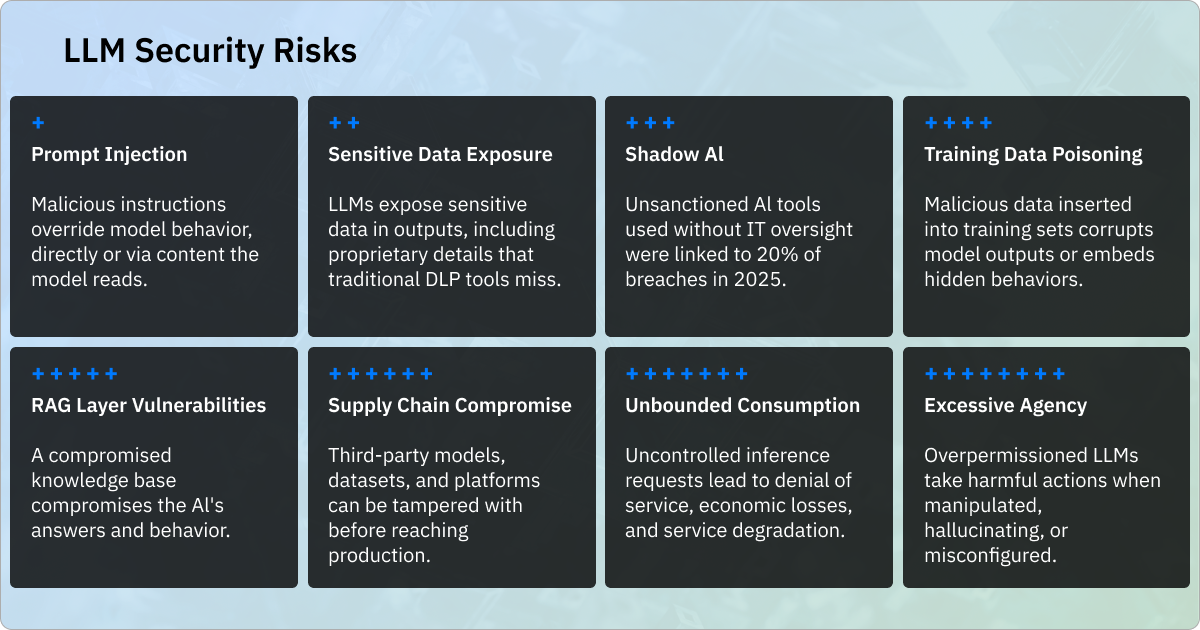
LLMs don't just create new versions of familiar risks. They open the door to threats that are fundamentally different and require specific detection mechanisms and controls. Here are some key vulnerabilities LLMs introduce:
Prompt Injection
Prompt injection is ranked #1 on the OWASP list of top LLM vulnerabilities. Reported prevalence varies by system and assessment methodology. One systematic review published in 2026 found that prompt injection attacks have progressed from simple direct injections to sophisticated multimodal attacks, achieving over 90% success rates against unprotected systems, with indirect injection via RAG (Retrieval-Augmented Generation) systems emerging as a primary attack vector.
Sensitive Data Exposure
Every AI conversation is a potential data channel. LLMs can expose sensitive data in their outputs, especially when they’re embedded in applications. Leaks of proprietary algorithms and confidential details can result in privacy violations and intellectual property breaches.
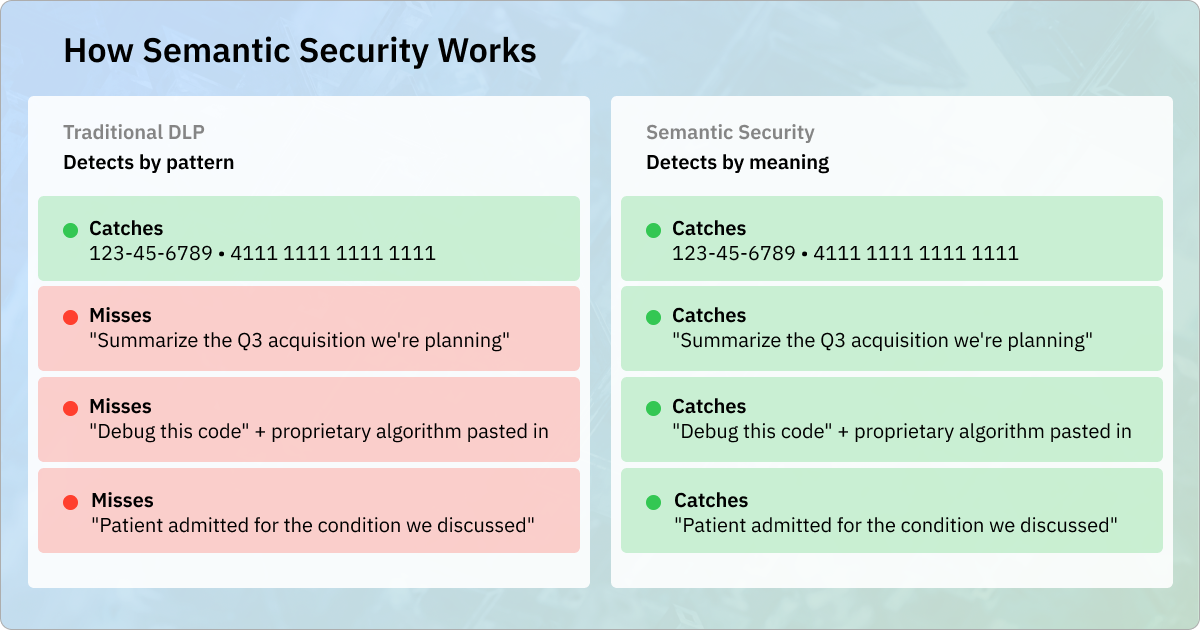
Traditional DLP tools scan files; they weren't designed for the natural language conversations of AI. An employee describing a confidential acquisition, summarizing an unannounced product, or asking a question that reveals patient information doesn't produce a file transfer or a recognizable data pattern.
Shadow AI
One in five organizations experienced breaches linked to shadow AI in 2025, according to an IBM report. Those incidents added as much as $670,000 to the average breach cost and disproportionately exposed customer PII and intellectual property. Among breached organizations that experienced AI-related incidents, 97% lacked proper AI access controls.
Training Data Poisoning
Training data poisoning lets attackers corrupt an LLM at its foundation. By inserting malicious data into training datasets, adversaries can skew model outputs, degrade accuracy, or embed hidden behaviors that activate under specific conditions. A recommendation engine trained on poisoned data might start promoting harmful products without any visible misconfiguration, undermining user trust and creating liability exposure.
RAG Layer Vulnerabilities
Retrieval-Augmented Generation (RAG) has become a common architecture for connecting LLMs to enterprise data. It gives models access to internal documents, knowledge bases, and proprietary content. When you connect AI to your proprietary data, you inherit all the responsibilities of safeguarding that data, plus new ones. If the knowledge base is compromised, the LLM’s answers and behavior can be influenced or compromised, too.
Supply Chain Compromise
The supply chain for a modern LLM application is long, involves multiple external parties, and largely lacks the security standards that govern traditional software procurement. In conventional software, supply chain risk means code flaws and dependency issues. For LLMs, supply chain risk extends to the third-party pre-trained models, datasets used for additional model training, and deployment platforms that organizations depend on but don't fully control. These can be tampered with or poisoned before reaching production.
Unbounded Consumption
Unbounded Consumption occurs when an LLM application allows users to conduct excessive and uncontrolled inferences. This exposes the organization to risk like denial of service, economic losses, model theft, and service degradation. The high computational demands of LLMs, especially in cloud environments, make them vulnerable to resource exploitation and unauthorized usage.
Excessive Agency
As LLMs gain the ability to take actions (executing code, calling APIs, querying databases, sending communications), risk grows. Poorly engineered prompts, hallucinations, and prompt injections can all lead to irreversible damage. The vulnerability isn't limited to malicious input: benign prompts that produce unexpected outputs can trigger the same harmful downstream actions as deliberate attacks.
In multi-agent systems, a compromised or malicious peer agent can trigger the same outcome. The root causes are consistently one of three things: the system has access to more functionality than it needs, it holds more permissions than the task requires, or it operates with more autonomy than appropriate human oversight allows.
What features should I look for in an LLM security tool?
Start with AI-native DLP, prompt inspection, and supply chain security.
Your security tools need to address the specific risks arising from LLM use. The network, endpoint, and identity controls most organizations have now weren't designed for LLMs that accept natural language instructions and generate unpredictable outputs. Here are the features that really matter when choosing a security tool:
1. AI-Native DLP (Semantic Security)
Rather than scanning for known data patterns, AI-native DLP evaluates the meaning and context of conversational content, identifying sensitive information expressed in natural language that would pass undetected through conventional DLP controls. This is a powerful tool to address the risks arising from LLM use.
2. Prompt inspection and injection detection
Look for a platform that sits in the path of LLM traffic, inspecting prompts before they reach models and responses before they reach users. Injection attempts (both direct and indirect) should be flagged through pattern analysis, behavioral signals, and semantic evaluation.
3. Supply chain security
Your provider should cover the supply chain threats that arrive before a model ever reaches production. It should scan models before deployment for backdoors, trojans, malicious code injections, and serialization vulnerabilities. To enable traceability and evidence, model cards and an AI Bill of Materials should document what went into building a model.
4. Access controls and gateway enforcement
A good platform will govern which models employees and agents can access, enforce data residency rules, and apply consistent policy across supported AI providers and access paths.
5. RAG pipeline protection
Look for a tool that secures the data pipelines that feed enterprise knowledge into LLMs, monitoring for poisoned content, enforcing access controls on retrieval sources, and ensuring that the knowledge base an LLM can draw from doesn't expose data.
6. Runtime behavioral monitoring
You need to surface incidents in real time and build an audit trail that shows appropriate oversight. Look for a platform that will detect anomalous model behavior, jailbreak attempts, and unexpected outputs in production.
What is semantic security?
AI-native security understands the meaning and context of LLM prompts.
Most DLP tools work by recognizing patterns: A Social Security number matches a known format, a credit card number has a recognizable structure, and a classified document has a known label. Traditional tools were built for a world where sensitive data had a shape, and you could detect it by what it looked like.
But LLM interactions don't work that way. When an employee asks a model to "summarize the acquisition we're planning for Q3," there's no pattern to match. When a developer pastes a proprietary algorithm into a prompt and asks for help debugging it, the code may not fit any known signature. When a healthcare worker describes a patient's condition in natural language to get a treatment suggestion, there isn’t a credit card number to detect. All of this information is highly sensitive, but you wouldn’t know it from the format.
Semantic security addresses this gap by recognizing meaning, not just patterns. Instead of asking whether the content matches a known format, it asks, "What does this content actually say, and is that sensitive in this context?" It identifies sensitive information regardless of how it's expressed.
Top 5 LLM Security Tools in 2026
The use of AI in enterprise operations is now almost universal, and it’s been one of the fastest and most transformative tech developments ever: Stanford's 2026 AI Index found that organizational adoption of AI reached 88%. Separately, it found that generative AI reached 53% population adoption within three years. That pace created a security gap that existing tools weren't designed to close. A new category of LLM security tools has emerged to close the gap.
Here’s our assessment of the leading LLM security tools on the market today (in no particular order).
Lakera Guard (Check Point)
Lakera was founded in Zurich in 2021 by former engineers from Google and Meta, and was acquired by Check Point Software Technologies to form the core of Check Point's enterprise AI security stack. Its flagship product, Lakera Guard, operates as a runtime security layer between users and LLMs, inspecting prompts and responses routed through it before the model processes input or the user receives output.
Lakera Guard’s detection models update continuously. They’re trained on a proprietary vulnerability database that grows each day, drawn partly from Gandalf, Lakera's interactive AI security game that has collected 80M+ prompts from over one million players attempting to extract information from a guarded model. This continuous training loop means Guard's detection intelligence reflects current attack patterns rather than historical ones.
Core capabilities cover direct and indirect prompt injection detection, jailbreak prevention, PII detection and redaction, secrets detection, custom data pattern matching, and content moderation. Lakera Red, the companion red teaming product, runs automated attack simulations against LLM applications to surface vulnerabilities before production; the two products cover complementary testing and runtime-protection use cases. The platform is API-first, integrating with a single endpoint in the OpenAI chat completions message format, and is available as SaaS or self-hosted containers.
Best for: Development teams and enterprises building LLM-powered products that need runtime protection with continuously updated threat intelligence.
First Recon AI
First Recon AI’s approach to LLM security is distinct. Rather than adding a control layer to the AI environment, it is the environment: A single safe workspace for security, governance, and productivity. This means that employees access supported AI providers (ChatGPT, Claude, Gemini, Copilot, and open-weight models) through one secure interface. A chat workspace offers users multi-model comparison, conversation, and prompt tools, all with AI-specific safeguards.
First Recon’s Semantic Security Engine adds a critical LLM-specific capability, evaluating the meaning and context of prompts and responses and catching sensitive content in natural language that would pass undetected through traditional DLP pattern-matching controls. For example, if an employee describes a confidential acquisition, it won’t match a predefined pattern, so it might get missed. Semantic Security will identify the sensitive information because it understands the meaning of what is said.
The AI Security Runtime inspects each prompt, response, and agent action on governed access paths, through to the model that answers. Each enforcement decision generates a structured audit record organized against the compliance frameworks configured for the organization. The platform's productivity stack (chat, agents, model access, and enterprise knowledge) means employees have a governed environment to work within rather than a set of restrictions to route around.
You can test First Recon’s LLM security capabilities through its 30-day free trial.
Best for: Enterprises of all sizes and sectors that want LLM productivity, governance, and security in a single app, with AI-native Semantic Security that analyzes behavior and intent, not just pattern matching.
HiddenLayer
HiddenLayer operates at the model layer, securing AI systems from the supply chain through to production runtime. The platform's AI Supply Chain Security capability scans models before deployment across 35+ formats, including PyTorch, TensorFlow, ONNX, GGUF, and safetensors. It detects malicious code injections, deserialization attacks, architectural backdoors, and trojans embedded in model layers, without requiring access to the original training data. This addresses the class of threats that arrive before a model ever reaches an enterprise environment, which conventional security scans aren't designed to catch. AI Attack Simulation continuously red-teams deployed models using adversarial techniques. Runtime security monitors models in production, detecting and blocking prompt injection, jailbreaks, and model evasion in real time.
HiddenLayer's March 2026 platform update extended runtime coverage specifically to agentic workloads, introducing agentic runtime visibility, investigation and threat hunting, and detection and enforcement for multi-step autonomous workflows.
Best for: Organizations building or deploying their own AI models, particularly those sourcing from public model hubs or open-source ecosystems where supply chain integrity and model-level runtime defense are the primary security concerns.
Varonis Atlas
Varonis launched Atlas in May 2026 as an end-to-end AI security platform covering the full AI security lifecycle from discovery through runtime protection and compliance. Atlas connects to hosted AI platforms, custom LLMs, agentic frameworks, chatbots, and embedded AI. It's built on the Varonis Data Security Platform and brings data context to AI security.
Atlas proactively stress-tests AI systems for prompt injection and jailbreaks and enforces real-time policies that prevent sensitive data leakage in LLM interactions. It monitors full end-to-end flows of AI activity with a single audit trail, including LLM calls and data access.
The platform’s Shadow AI discovery surfaces unsanctioned LLM usage across the environment, while AI Detection and Response generates real-time alerts on suspicious behavior with SIEM and SOAR integration. Third-party AI risk management covers LLMs accessed through the supply chain alongside internally deployed systems. The data security foundation is the platform's core differentiator. Atlas doesn't just monitor what an LLM is doing; it maps the sensitive data the LLM can reach and enforces access boundaries at that layer.
Best for: Organizations that need LLM security with data context, particularly those already using Varonis who want to extend that visibility into the AI and LLM layer without a separate platform.
Symmetry Systems (Zscaler)
Symmetry Systems approaches security through a data-first lens. Its premise is that what matters most isn't just what an LLM is doing, but the data it can reach. Symmetry AIGuard monitors both sanctioned and unsanctioned external LLM usage through proxy integrations, identifying which models are in use, who is using them, what data is being shared in prompts, and whether usage violates corporate policy, with real-time prompt and response monitoring surfacing violations as they happen.
AIGuard is built on the same identity and data graph behind Symmetry DataGuard. That means it doesn't just monitor AI activity; it connects models, agents, services, and users across connected environments to the sensitive data they can reach and gives organizations the controls to act on what they find. The platform inventories supported Copilot deployments, LLMs, and RAG pipelines, maps exactly what data they can reach, and enforces scope policies in real time. Deployment runs inside the customer's own cloud environment (AWS, GCP, Azure, OCI, or on-premises), so sensitive data never crosses boundaries it shouldn't, with air-gapped deployment available for defense, federal, and healthcare environments.
The interaction layer is the new perimeter
The pace and scale of LLM adoption are staggering. So is the security exposure it brings. Employees are using generative AI tools faster than IT can inventory them, and LLMs are now embedded in clinical documentation, legal research, financial analysis, and customer interactions across every major industry. The interaction layer has become one of the highest-risk surfaces in an enterprise.
The right LLM security platform will not just help teams manage these risks today; it will prepare them to respond to new threats that are rapidly unfolding.